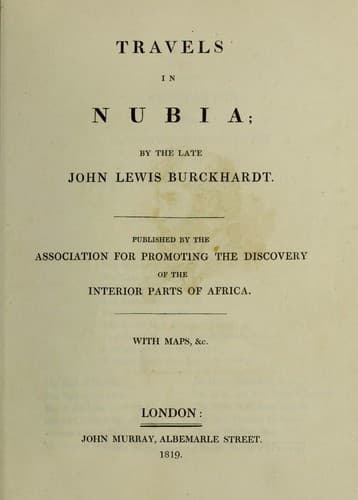
Burckhardt, John Lewis, 1784-1817; Nile River Valley -- Description and travel; Nubia -- Description and travel
The Sheygya, of whom I have seen only one individual, at Mahass,
are certainly a very interesting people, and form the most powerful
state to the north of Sennaar. They have a tradition that their
forefather was a man of the name of Shayg (شايق), whose four sons
gave origin to their principal tribes. At present they are divided
into many tribes, of which the Adelanab is the most powerful, being
that of the great chief; the others are: El Hamdan (حمدان);
Essoleymane (سليماني); and El Amrab (الامراب); to
these may be added the tribes of Onye, Zebeyr (which must not be
confounded with the royal family of Argo, to which they have no
relationship), and the Arabs Menasyr (عَرَب المناصِر),
who inhabit the Wady Menasyr, to the east of the country of the
Sheygya, and who, although not strictly belonging to the Sheygya,
may, from their intimate connection with them, be enumerated among
their tribes. These different people are continually at war with
each other, and their youth make plundering excursions as far as
Darfour, to the west, and Wady Halfa, to the north. They all fight
on horseback, in coats of mail (ذرع), which are sold to them
by the merchants of Suakin and Sennaar. Fire-arms are not common
among them, their only weapons being a lance, target, and sabre;
they throw the lance to a great distance with much dexterity, and
always carry four or five lances in the left hand, when charging
an enemy. They are all mounted on Dóngola stallions, and are
as famous for their horsemanship, as the Mamelouks were in Egypt;
they train their horses to make violent springs with their hind legs
when gallopping; their saddles resemble the drawings I have seen of
those of Abyssinia, and, like the Abyssinian horsemen, they place
the great toe only in the stirrup. It is from the Sheygya that the
people of Mahass are supplied with saddles.
The Sheygya are a perfectly independent people, and possess great
wealth, in corn and cattle; like the Bedouins of Arabia, they pay
no kind of tribute to their chiefs, whose power is by no means so
great as that of the chiefs of Dóngola. They are renowned for
their hospitality; and the person of their guest, or companion,
is sacred. If the traveller possesses a friend among them, and has
been plundered on the road, his property will be recovered, even if
it has been taken by the king. They all speak Arabic exclusively,
and many of them write and read it. Their learned men are held in
great respect by them; they have schools, wherein all the sciences
are taught which form the course of Mohammedan study, mathematics
and astronomy excepted. I have seen books, copied at Merawe, written
in as fine a hand as that of the scribes of Cairo. Whenever young
men are sent to them from the adjacent countries for instruction,
the chief of the Olema distributes them amongst his acquaintances,
in whose houses they are lodged and fed for as many years as they
choose to remain.
Public-domain text, read in full here on John Shaqi.
Reviews
Reviews
No reviews yet
Be the first to share your thoughts on this work.
Elsewhere in the archive
Join the Discussion
Join the discussion
Sign in to leave a comment or review.
Sign InorCreate an account