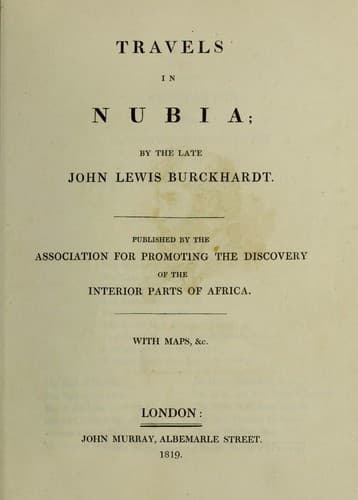
Burckhardt, John Lewis, 1784-1817; Nile River Valley -- Description and travel; Nubia -- Description and travel
to be called a Cataract, or Shellal (شلّال).[49] There are
three principal falls, or sloping rocks, one above the other, over
which the water descends with great velocity. The Arabs who inhabit
some of the neighbouring islands, stretch a net across the fall,
and in this way catch a considerable number of fish. The high hill
on the west bank, close to the Cataract, forms the termination of
the primitive rocks of the Batn el Hadjar; from thence northward,
as far as the first Cataract, the rock is everywhere sand-stone.
As the sun was near setting, when I viewed the Cataract, and our
provisions, except Dhourra, were entirely exhausted, I was desirous
of reaching some inhabited spot before night, and therefore proceeded
at a quick trot. In the course of our passage over the sand hills
we came opposite to Wady Halfa; and in ten hours reached the banks
of the river in front of Sukoy (سقوي), where I met with the
remains of a temple, but in a very dilapidated state. The whole
building is buried under mounds of sand and rubbish, except the
[Illustration] fragments of shafts of columns, standing as described
in the annexed figure. The four corner columns, and two of the side
ones, are square, the others are round; they appeared to be about
two feet and a half in diameter; no hieroglyphics, or sculptures,
are visible, and the stones are in a very decayed state. The temple
had been surrounded by a high brick wall, fragments of which are
still seen. I observed no other remains of antiquity in my hasty
view of this ruin. We continued at a brisk trot till the end of
eleven hours and a half, when we again reached the bank of the
river, opposite Dabrous, and crossed the dry bed of a branch of
the stream to an island, where some Kerrarish Arabs were encamped,
and we alighted at their tents, late at night, after a ride of
twelve hours. I celebrated my safe return into the northern parts
of Nubia by having a lamb, which I purchased of the Arabs for three
measures of Dhourra, roasted for my supper. The island is thickly
overgrown with tamarisk trees, which shoot up spontaneously upon
all the islands whose surfaces consist of alluvial mud, and not of
sand. I was informed, in the course of the night, that a caravan
of sixty camels of the Arabs Sheygya had arrived at Wady Halfa,
for dates. Although continually harassed by the predatory incursions
of the Sheygya, the Nubians never offer any insult to the merchants
of that nation, who visit their villages as friends.
Public-domain text, read in full here on John Shaqi.
Reviews
Reviews
No reviews yet
Be the first to share your thoughts on this work.
Elsewhere in the archive
Join the Discussion
Join the discussion
Sign in to leave a comment or review.
Sign InorCreate an account