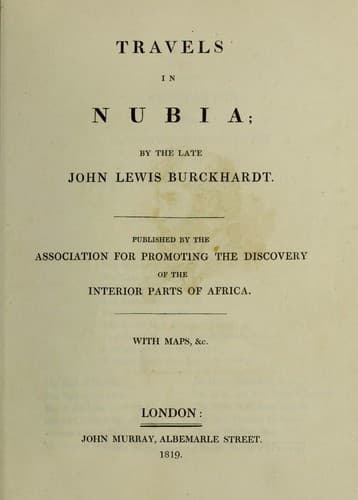
Burckhardt, John Lewis, 1784-1817; Nile River Valley -- Description and travel; Nubia -- Description and travel
_March 26th._ In one hour and a half we came to Wady Medyk, which
stands on both sides of the river. The Senna-mekke grows here in
large quantities. The inhabitants of Medyk who retired to Esne
after the passage of the Mamelouks, had not yet returned. Many
of them died there of the small-pox.[53] In two hours and a half,
we passed opposite to Wady Nasrellab. In three hours and a half,
we came to El Nowabat, a ruined village, opposite to Thyale on the
east bank. The shore is here very narrow, and the western hills are
low, and sandy. At five hours and a half, we saw, upon the hills,
the ruins of several Greek churches. Seven hours, El Meharraka,
on both sides of the Nile. Upon the rocky hill, over the river,
stands a small ruined city, the houses of which had been built
partly of small stones, and partly of mud; they are of Arab
construction. Eight hours and a half brought us to the northern
extremity of Wady Meharraka, where the plain widens considerably,
being broader than in any other part north of Derr; though it is
cultivated at present only near the river. Here is the ruin of a
temple, consisting of a portico of fourteen massy columns, with
capitals of different sizes and [Illustration] forms, according to
the ancient Egyptian taste in architecture. They are encompassed
by a wall, which being joined to the entablature of the colonnade,
forms a covered portico all round. The southern wall has
fallen down, apparently from some sudden and violent concussion,
as the stones are lying on the ground, in layers, as when placed in
the wall; a proof that they must have fallen all at once. I observed
some hieroglyphics sculptured upon single stones lying about in
this part. The columns on the south side are joined to each other,
except the two centre ones, by a low wall, half their height, in
the same manner as those in the temple of the hawk-headed Osiris
at Philæ. There is one large entrance, and two smaller ones, and a
stair-case leading up to the top. Several paintings of Greek saints
are upon the walls; but no hieroglyphics, nor sculptures, of any
kind, are visible, not even the globe, common to all the Egyptian
temples; neither are there any sculptures on the columns. The walls
of this ruin are very neatly and well constructed. There are several
Greek inscriptions upon them, in red ink; but I could only read
the following clearly:
[Illustration]
I also copied the following inscription, which is upon the wall;
but I am unacquainted with the characters, and have no opportunity
at present of ascertaining what they are:
[Illustration]
There are besides, several inscriptions in the ancient popular
Egyptian character, such as is seen on the manuscripts of papyrus.
Public-domain text, read in full here on John Shaqi.
Reviews
Reviews
No reviews yet
Be the first to share your thoughts on this work.
Elsewhere in the archive
Join the Discussion
Join the discussion
Sign in to leave a comment or review.
Sign InorCreate an account