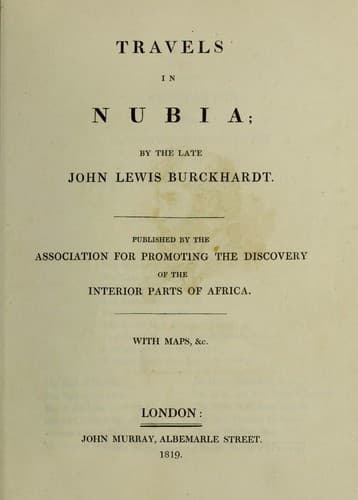
Burckhardt, John Lewis, 1784-1817; Nile River Valley -- Description and travel; Nubia -- Description and travel
There are large mounds of rubbish, and fragments of pottery, in
this place. Several travellers have expressed their astonishment
at the immense heaps of rubbish consisting chiefly of pottery which
are met with on the sites of ancient Egyptian towns; and, if we are
to attribute their formation to the accumulation of the fragments
of earthen vessels used by the inhabitants for domestic purposes,
they are indeed truly surprising; but I ascribe their origin to
another cause. In Upper Egypt, the walls of the peasants houses
are very frequently constructed in part of jars placed one over
the other, and cemented together with mud; in walls of inclosures,
or in such as require only a slight roof, the upper part is very
generally formed of the same materials; in the parapets also of the
flat-roofed houses a double or triple row of red pots, one over the
other, usually runs round the terrace, to conceal the females of the
family when walking upon it. Pots are preferred to brick, because
the walls formed of them are lighter, more quickly built, and have a
much neater appearance. They possess, likewise, another advantage,
which is, that they cannot be pierced at night by robbers, without
occasioning noise, by the pots falling down, and thus awakening
the inmates of the dwelling, while bricks can be removed silently,
one by one, as is often done, by nightly depredators, who break
into the houses in this manner. If then we suppose that pot walls
were in common use by the ancient inhabitants, the large mounds of
broken pottery may be satisfactorily accounted for. As for stone,
it seems to have been as little used for the private habitations
of the ancient Egyptians, as it is at the present day.
Near Wady Meharraka the island of Derar commences. At eight hours
and three quarters is the village of Korty. About two hundred yards
from the river stands a ruined temple; it is the smallest I have
seen, and may truly be called an Egyptian temple in miniature,
being only ten paces in length; the cella and adytum are yet
standing; the pronaos seems to be buried under the sand. Of the
sculptures, a few figures, and the winged globe over the gates,
remain; but the whole temple is in a very mutilated state. At the
end of nine hours and a half, we stopped at the house of a Shikh,
on the southern extremity of Wady Dakke (وادي دقّه).
Public-domain text, read in full here on John Shaqi.
Reviews
Reviews
No reviews yet
Be the first to share your thoughts on this work.
Elsewhere in the archive
Join the Discussion
Join the discussion
Sign in to leave a comment or review.
Sign InorCreate an account