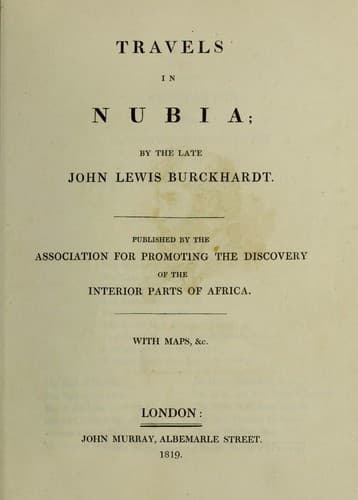
Burckhardt, John Lewis, 1784-1817; Nile River Valley -- Description and travel; Nubia -- Description and travel
In two hours, we came to Merowau (مرواو); the shore is no where
more than fifty yards in breadth; but is well cultivated. Merowau
belongs to Wady Gharby Dandour. Four hours and a half, Abou Hor. In
the rock, a little to the south of this place, a reservoir has been
cut, with an outlet, through which the water descends into a lower
and smaller basin; it is difficult to conceive for what purpose they
were intended, being so near the river. There are many jetties or
piers in the river, which prove how anxious the ancient inhabitants
had been to preserve and increase the portion of cultivable soil in
this part. Here are some rocky islands. In the sides of the western
hills adjoining Merowau and Abou Hor, are several small quarries,
and the foundations of ancient stone buildings. Like their ancestors,
the Nubians of the present day build their huts of stone, upon the
declivity of the hills, wherever the shore is very narrow, that
they may not encroach upon the cultivable ground. Where the plain
is broad their dwellings stand in the midst of it, and are formed
of mud only. Date trees, and the various species of acacia, grow all
along the shore; the latter produces, in the spring, a bitter fruit,
in shape like that of the Karoub, or locust tree; this the Arabs
gather and sell at Assouan to the merchants of Egypt, who use it in
tanning leather; it is called Garad (قَرَظ). Large quantities
of it, of a superior quality, grow in the neighbourhood of Siout,
and have rendered the tanneries of that place highly celebrated.
Public-domain text, read in full here on John Shaqi.
Reviews
Reviews
No reviews yet
Be the first to share your thoughts on this work.
Elsewhere in the archive
Join the Discussion
Join the discussion
Sign in to leave a comment or review.
Sign InorCreate an account