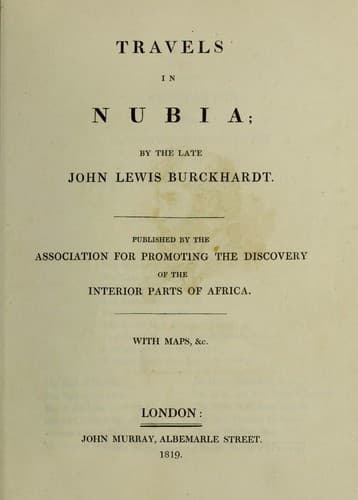
Burckhardt, John Lewis, 1784-1817; Nile River Valley -- Description and travel; Nubia -- Description and travel
in which the assault and capture of a tower are represented;
a man, with an axe in his hand, is endeavouring to make a breach
in the walls, from which some of the garrison are precipitated,
while others are brought in prisoners. All these subjects are in
bas-relief, and extremely well executed; they are the best specimens
of historical sculpture that I have seen in the valley of the
Nile, even more spirited than those at Thebes; the figures of the
animals, in particular, are faithfully and correctly delineated. On
considering the subjects they represent, they will be found very
important, because they record a historical fact, no where else
alluded to in any Egyptian structure. The hero of Egypt has here
carried his arms into a country inhabited by lions, cameleopards,
apes, and elephants: none of which animals are found in Nubia or
Dóngola; the elephant and cameleopard inhabit the banks of the
Nile towards Sennaar, the forests on the frontiers of Abyssinia,
and the banks of the Astaboras and Astapus, from whence also the
most beautiful and highest esteemed female slaves are now imported
into Egypt: all the above-described trophies of victory, therefore,
indicate, that the battles must have been fought in the countries
to the south of the civilized country of the ancient Meroe; for the
skin-clad prisoners denote a savage people. The battle-pieces of
Thebes, at Luxor and Karnac, seem to allude to less distant scenes of
warfare. May not the castles, surrounded with water, which are there
represented, relate to the fortified islands in the Batn el Hadjar,
where we still meet with so many brick ruins? The head-dress of
the fugitives, which is close-cut hair, and not a cap, as has been
erroneously described, and the short, narrow beard, under the chin,
are perfectly characteristic of the southern Noubas, whose colour
is not quite black, but of that deep copper tinge, which a painter,
unskilled in mixing colours, would rather represent by dark red
than black. It may readily be imagined, that the inhabitants of
the sterile districts of Nubia, and the Batn el Hadjar, would look
with an envious eye upon the riches of Egypt, and would frequently
excite the resentment of the monarchs of Thebes, by making inroads
from their strong-holds, upon the adjacent provinces of Egypt.
Public-domain text, read in full here on John Shaqi.
Reviews
Reviews
No reviews yet
Be the first to share your thoughts on this work.
Elsewhere in the archive
Join the Discussion
Join the discussion
Sign in to leave a comment or review.
Sign InorCreate an account