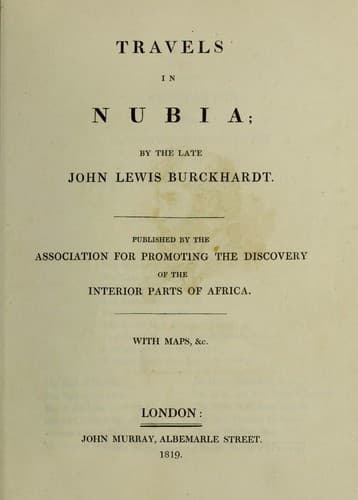
Burckhardt, John Lewis, 1784-1817; Nile River Valley -- Description and travel; Nubia -- Description and travel
When I left the camp of Mohammed
Kashef at Tinareh, his nephew ran after me for at least two miles,
to obtain a single cartridge from me, telling me that he had shot
off the only one he had, during the rejoicings of the preceding day.
I have already mentioned the usual dishes of the Nubians. The
Dhourra bread is extremely coarse, and is made without salt.[69]
It is prepared upon the Sadj, or thin iron plate in use among the
Bedouin Arabs; but as the whole operation of grinding, kneading,
and baking does not occupy more than ten minutes, it may easily be
supposed that it is never thoroughly baked. The Dhourra for the
day’s use is ground early every morning by the women, for the
Nubians never keep meal in store. In Sukkot and Mahass, the bread
is made in very thin round cakes, which are placed upon each other
when served up at meals. Animal food is rarely tasted by the Nubians;
the governors even do not eat it every day. In the larger villages
palm-wine is common; it is not unpleasant to the taste, though
too sweet and thick, to be drank in any considerable quantity. It
is obtained by the following process: as soon as the dates have
come to maturity they are thrown into large earthen boilers, with
water, and the whole is boiled for two days, without intermission;
the liquid is then strained, and the clear juice is poured into
earthen jars, which after being well closed, are buried under
ground; here they are allowed to remain for ten or twelve days,
during which the liquor ferments; the jars are then taken up,
and their contents are fit to drink; but the wine will not keep
longer than a year, or beyond the next date-harvest; if kept longer
it turns sour. The Nubians also make a liquor called Bouza, much
resembling beer; it is extracted from Dhourra or barley, but the
best is furnished by the latter. It is of a pale muddy colour,
and very nutricious. At Cairo, and in all the towns and larger
villages of Upper Egypt, there are shops for the sale of Bouza,
which are kept exclusively by Nubians. Great quantities both of the
wine, and of the spirit distilled from dates, are drank at Derr,
where they are sold in shops kept for the purpose, and where the
upper classes are intoxicated with them every evening. From Siout,
southward, through the whole of Upper Egypt, date spirits are made
and publicly sold; and the Pasha levies a tax upon the venders. A
kind of jelly or honey is also extracted from the date, which serves
the rich as a sweet-meat. Except date trees, and a few grape vines
which I saw at Derr, there are no fruit-trees in Nubia.
Public-domain text, read in full here on John Shaqi.
Reviews
Reviews
No reviews yet
Be the first to share your thoughts on this work.
Elsewhere in the archive
Join the Discussion
Join the discussion
Sign in to leave a comment or review.
Sign InorCreate an account