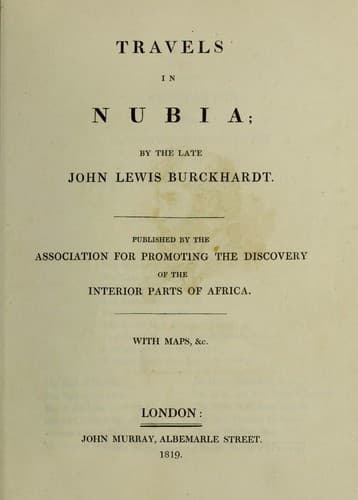
Burckhardt, John Lewis, 1784-1817; Nile River Valley -- Description and travel; Nubia -- Description and travel
The Nubians purchase their wives from the parents: the price usually
paid by the Kenous is twelve Mahboubs, or thirty-six piastres. They
frequently intermarry with the Arabs Ababde, some of whom cultivate
the soil like themselves; an Ababde girl is worth six camels; these
are paid to her father, who gives back three to his daughter, to
be the common property of her and her husband; if a divorce takes
place, half the value of the three camels goes to the latter.[70]
In Upper Egypt, when a wife insists upon being divorced, her
husband has the right to take all her wearing apparel from her,
and to shave her head; nobody will then marry her till her hair
be grown again. The Nubian is extremely jealous of his wife’s
honour; and on the slightest suspicion of infidelity towards him,
would carry her in the night to the side of the river, lay open
her breast by a cut with his knife, and throw her into the water,
“to be food for the crocodiles,” as they term it. A case of
this kind lately happened at Assouan.
Public women, who are met with in thousands in every part of
Egypt, are not tolerated in Nubia, except at Derr, and these
are not natives, but emancipated female slaves, who being left
destitute, betake themselves to this vile profession, to gain a
subsistence. The execrable propensities which the Mamelouks have
rendered so common in Egypt, even amongst the lowest peasants,
are held in abhorrence in Nubia, except by the Kashefs and their
relations, who endeavour to imitate the Mamelouks in every thing,
even in their most detestable vices.
Small looms are frequently seen in the houses of the Nubians; with
these the women weave very coarse woollen mantles, and cotton cloth,
which they make into shirts. From the leaves of the date-tree they
also form mats, small drinking bowls, and large plates on which
the bread is served at table; and though these articles are formed
entirely by the hand, they are made in so very neat a manner, as to
have every appearance of being wrought by instruments. The above
are the only manufactures in Nubia; every thing else is imported
from Egypt.
[Illustration]
The only musical instrument I saw in Nubia was a kind of Egyptian
tamboura, with five strings, and covered with the skin of a gazell:
it is of the shape here represented. The girls are fond of singing;
and the Nubian airs are very melodious.
The game of chess is common at Derr; and that called Beyadh is
also frequently played. I have described the latter in my journal
through Arabia Petræa, when speaking of the Arabs of Kerek.
Public-domain text, read in full here on John Shaqi.
Reviews
Reviews
No reviews yet
Be the first to share your thoughts on this work.
Elsewhere in the archive
Join the Discussion
Join the discussion
Sign in to leave a comment or review.
Sign InorCreate an account