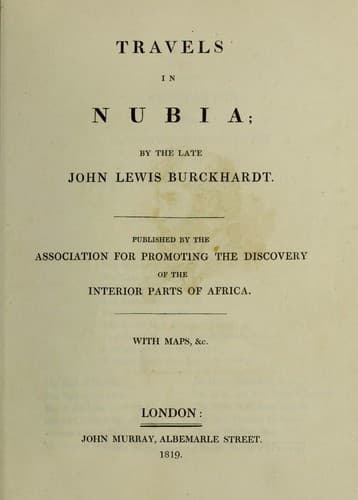
Burckhardt, John Lewis, 1784-1817; Nile River Valley -- Description and travel; Nubia -- Description and travel
The Bisharye, who rarely descend from their mountains, are a
very savage people, and their character is worse even than that
of the Ababde. Their only cattle are camels and sheep, and they
live entirely upon flesh and milk, eating much of the former raw;
according to the relation of several Nubians, they are very fond of
the hot blood of slaughtered sheep; but their greatest luxury is said
to be the raw marrow of camels. A few of these Arabs occasionally
visit Derr or Assouan, with Senna, sheep, and ostrich feathers,
the ostrich being common in their mountains; and their Senna is of
the best kind. In exchange for these commodities they take linen
shirts and Dhourra, the grains of which they swallow raw, as a
dainty, and never make it into bread. These traders do not remain
long on the banks of the Nile, as the dread of the small-pox soon
drives them back to their tents. The Bisharye are much addicted
to theft, and will even rob the house of the person who receives
them as guests. Their youth make plundering excursions as far as
Dóngola, and along the route to Sennaar, mounted upon camels, of a
breed superior to any other, that exists between the shores of the
Mediterranean and Abyssinia. Few of the Bisharye speak Arabic. They
fear none but the Ababde, who know their pasturing places in the
mountains, and often surprise their encampments. When the two
tribes are at peace, which happens to be the case at present, the
mountains inhabited by the Bisharye may be crossed in the company
of an Ababdi; but the latter is not to be trusted, unless one of his
nearest relations is left behind as a hostage. Great numbers of the
dispersed Mamelouks fell victims to the treachery of these Arabs, and
the others escaped only by keeping together in considerable bodies.
Encampments of the Bisharye are found on the northern frontier of
Abyssinia; and the sea-coast from Suakin to Massuah is peopled by
their tribes, the most noted of which are, Hammedab, Batra, Alyab,
Amerab, Kamhetab, Hamdora, Eryab, Hazz, Modourab, Kameylab, el
Amarer, all of whom live in separate encampments, and are often at
war with each other. They have no fire-arms; towards the frontiers
of Abyssinia some of the tribes use the bow and arrow, and, as I was
informed, speak the Abyssinian language, or rather understand the
Abyssinians, who are said to have greater difficulty in comprehending
the Bisharye. The two languages are probably derived from the same
source, like many others of the numerous dialects which prevail
towards the northern frontiers of Abyssinia.
Public-domain text, read in full here on John Shaqi.
Reviews
Reviews
No reviews yet
Be the first to share your thoughts on this work.
Elsewhere in the archive
Join the Discussion
Join the discussion
Sign in to leave a comment or review.
Sign InorCreate an account