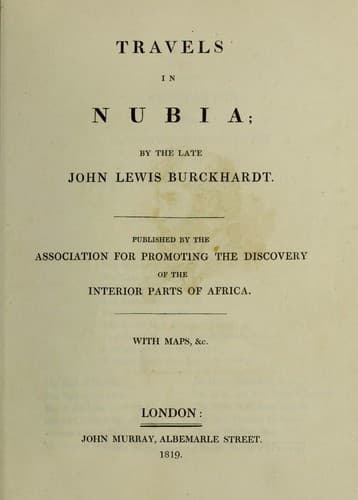
Burckhardt, John Lewis, 1784-1817; Nile River Valley -- Description and travel; Nubia -- Description and travel
[Footnote 65: In November 1813, Mohammed Kashef arrived at Esne,
in his way to Siout, for the purpose of visiting Ibrahim Pasha,
the governor of Upper Egypt, who, it was well known, entertained
hostile designs against Nubia. Being anxious to conciliate the
Pasha, he had brought with him presents of slaves, dromedaries,
and Dóngola horses; but the chief object of the Kashef’s journey
was to complain against Hosseyn, his eldest brother, who had lately
invested his two eldest sons, Daoud and Khalil, with a share of the
government of Nubia, and had obliged his two brothers to divide the
revenue equally, with their nephews, thus creating five governors
of the country. At Esne, Mohammed met a troop of about one hundred
soldiers, who had been dispatched by Ibrahim Pasha, against Nubia;
deeming it useless, therefore, to proceed farther, he returned
towards his home with the Turks, at whose approach his two brothers
fled to the island of Okme, beyond the second cataract at Wady Halfa,
notwithstanding every promise of safety. The Turks pursued their
march as far as Wady Halfa, collecting from every Sakie in the name
of Ibrahim Pasha, the land-tax, of which they allowed Mohammed Kashef
about one-twelfth of the whole amount, for his own subsistence. It
was evidently the object of this expedition to seize the persons
of all the governors; but in this it failed. After staying nearly
a year in the country, in the course of which they collected the
land-tax, from the summer seed also, the Turks returned to Upper
Egypt. In 1815, the Turks again visited Nubia, and compelled the
peasants to furnish the amount of the imposts in camels, instead
of grain; as soon as they withdrew, the Kashefs returned to Derr,
and, in their turn also exacted the land-tax from their subjects,
who are now exposed both to the rapacity of the Turks and to that of
their own governors, all equally merciless, owing to the uncertain
duration of their respective powers.]
[Footnote 66: In 1813, the taxes levied upon the above produce from
every Sakie, was eight Erdebs; and wherever the governors of Nubia
repaired in person to the village, to collect it, an additional
assessment of four fat sheep and one Erdeb was made, as provision
for the governor’s followers and horses.]
[Footnote 67: The quantity of dates imported from Nubia, by way
of Assouan, into Egypt varies, according to the harvest, from
fifteen hundred to two thousand Erdebs annually; every Erdeb
weighing about two hundred weight. The freight from Assouan to
Cairo is five piastres per Erdeb, from each of which the governor
of Assouan takes half a piastre, as transit duty. The date trade,
which is extremely profitable, is now, for the greater part, in
the hands of the government.]
Public-domain text, read in full here on John Shaqi.
Reviews
Reviews
No reviews yet
Be the first to share your thoughts on this work.
Elsewhere in the archive
Join the Discussion
Join the discussion
Sign in to leave a comment or review.
Sign InorCreate an account