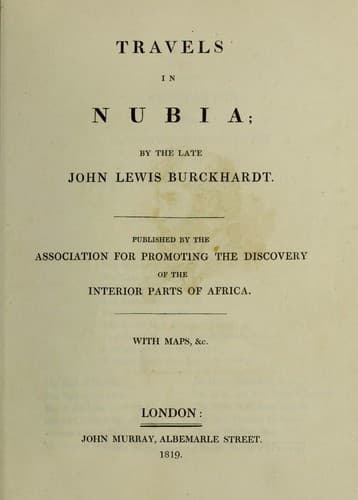
Burckhardt, John Lewis, 1784-1817; Nile River Valley -- Description and travel; Nubia -- Description and travel
called by the Bisharein El Dodda, which is preferred to the Sellam,
for making these sticks. It grows nearer to the Red Sea. In the
Wady Abou Borshe we met with some gazelles, the first we had seen
since leaving Daraou; where water is only found in deep wells,
it cannot be supposed that game much abounds.
_13th March._ We set out before sun rise, and reached, after three
hours, Wady el Berd (وادي البرد), a fine wide valley
overgrown with trees. Large flocks of white birds, of the size of
geese, passed over our heads, on their way northwards. The Arabs
have given this valley the name of Berd (cold), because they find
that even in summer, a cold breeze always reigns here; it is open
to the Nile, from whence the winds at that time generally blow. We
found it at the early hour of the morning in which we passed it so
extremely cold, that during a short halt we set fire to several dead
trees, of which there are many in the Wady. Having continued our way
along it for about two hours, and then crossed a chain of hills,
we halted again during the mid-day hours, in another valley. The
halting at noon always gave rise to disputes. Whenever it was known
before hand that the chiefs intended to stop in a certain valley,
the young men of the caravan pushed eagerly forwards, in order
to select at the halting place the largest tree, or some spot
under an impending rock, where they secured shelter from the sun
for themselves and their mess. Every day some dispute arose as to
who arrived the first, under some particular tree: as for myself I
was often driven from the coolest and most comfortable berth, into
the burning sun, and generally passed the mid-day hours in great
distress: for besides the exposure to heat, I had to cook my dinner,
a service which I could never prevail upon any of my companions,
even the poorest servants, to perform for me, though I offered to
let them share in my homely fare. In the evening, the same labour
occurred again, when fatigued by the day’s journey, during which
I always walked for four or five hours, in order to spare my ass,
and when I was in the utmost need of repose. Hunger however always
prevailed over fatigue, and I was obliged to fetch and cut wood to
light a fire, to cook, to feed the ass, and finally to make coffee,
a cup of which, presented to my Daraou companions, who were extremely
eager to obtain it, was the only means I possessed of keeping them
in tolerable good humour. A good night’s rest, however, always
repaired my strength, and I was never in better health and spirits
than during this journey, although its fatigues were certainly very
great, and much beyond my expectation. The common dish of all the
travellers at noon was Fetyre (فطيره), which is flour mixed up
with water into a liquid paste, and then baked upon the sadj, or iron
plate; butter is then poured over it, or honey, or sometimes a sauce
is made of butter and dried Bamyé. In the evening some lentils are
Public-domain text, read in full here on John Shaqi.
Reviews
Reviews
No reviews yet
Be the first to share your thoughts on this work.
Elsewhere in the archive
Join the Discussion
Join the discussion
Sign in to leave a comment or review.
Sign InorCreate an account