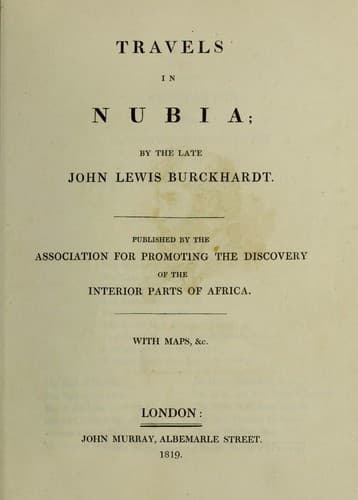
Burckhardt, John Lewis, 1784-1817; Nile River Valley -- Description and travel; Nubia -- Description and travel
_April 8th._ There are many ruins of modern buildings at Goz,
which is now in decay; formerly, it was the chief place in Berber,
and it is so mentioned by Bruce. In several places are public wells
or pits of brackish water, where travellers water their beasts,
the banks of the river being steep, and the descent to it very
difficult. We pursued our way along the skirts of the desert,
over a perfectly level plain or arable track of land, about two
miles in breadth, which lay between us and the Nile. The ground
was every where overgrown with the Oshour tree (عُشور), so
often mentioned in my journey along the Nile towards Dóngola,
and in the previous one through Arabia Petræa. Our path was well
trodden, and might be called a high road; numerous paths diverged
from it in every direction into the eastern desert. After about two
hours march, we reached a woody tract, where Sant and Sellam trees
grow. The country on the western side of the Nile was, as far as
I could see, perfectly flat, without any mountains or hills; but
a white line, indicating the sands of the desert, was every where
discernible beyond the narrow stripe of arable land which borders
the course of the stream. We met many travellers, on horseback
and on dromedaries, and women and children either riding alone on
asses, or driving loaded asses before them. This road appears to be
perfectly safe for the inhabitants of the country, though it would
not be so for strangers, without a proper guide. We had taken two
men from Ankheyre to escort us to the limits of the Wady Berber. At
the end of three hours and a half, we entered the district of Ras el
Wady; and at the end of four hours reached the village of that name
(راس الوادي), where we were obliged to stop, as a transit
duty is here levied upon merchants. Ras el Wady is a considerable
village, larger than Ankheyre, but not so well built, and containing
many huts made of mats. We went straight to the Mek’s dwelling,
and encamped on the open ground before it. This Mek, whose name is
Hamze, is a relation of Noureddyn, the Mek of Berber (مك حمزه
ابن عم المك نورالدين في بربر), but is quite
independent of him, Ras el Wady being a principality of itself,
although I think that most of its inhabitants are Meyrefabs, and
of the same tribe with those who people Berber. Like the latter
place, however, it is subject to the king of Sennaar, by whom the
Mek is appointed. Hamze is much dreaded by the caravan travellers,
especially the Egyptians. The Daraou traders supposing that they
might, perhaps, on my account, experience some ill treatment from
this chief, and convinced, at all events, that my society could no
longer be of any advantage to them, as they saw that I fought for
every handful of Dhourra, determined to abandon me entirely. We had
halted for some minutes in the plain, near a pond of water, before
the village. On starting again, they ordered me, in a contemptuous
manner, to keep off, and not to come near their party any more. The
Public-domain text, read in full here on John Shaqi.
Reviews
Reviews
No reviews yet
Be the first to share your thoughts on this work.
Elsewhere in the archive
Join the Discussion
Join the discussion
Sign in to leave a comment or review.
Sign InorCreate an account