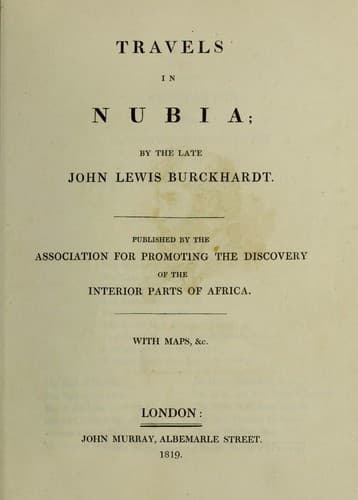
Burckhardt, John Lewis, 1784-1817; Nile River Valley -- Description and travel; Nubia -- Description and travel
At a short distance from the hamlets, we came to a great number of
new tombstones, in the desert, the melancholy proofs of the terrible
ravages of the small-pox. According to the Nubian custom, and which
I had already observed in the Berábera country, every tomb was
covered with white pebbles, and pieces of quartz. The plain of the
eastern desert is here interrupted by several sandy and gravelly
hillocks. At the end of four hours, after passing through a wood of
acacia trees, we reached the river Mogren (مُقرن), not Mareb,
as Bruce writes it, a name quite unknown here. After descending a
high bank, we passed for at least a mile, over deep sands in the
bed of the river, and then came to a pool of stagnant water, about
twenty paces broad, where the water reached up to the ankle: in many
places there were similar pools, but no where any running stream. I
estimated the height of the banks at thirty feet, and I observed
the high-water marks to be about twenty feet from the bottom, from
whence it is evident that this river can never inundate the adjacent
country; indeed this fact was confirmed by my companions, who told
me that during the time of high-water they pass the river in a boat
brought from Damer for the purpose, and that they had never seen the
country on either side of the river inundated, except by the waters
of the Nile. The verdant banks of the Mogren, covered with fresh
herbage and tamarisk bushes, afforded a delightful scene, which I
was permitted to enjoy for a full hour, as many of the camels, in
ascending the steep banks on the south side of the river, stumbled,
and threw their loads, thus occasioning a delay.
The Mogren forms the boundary between the territories of Ras el Wady
and Damer. On its southern banks several water-wheels were at work,
drawing up the water from some of the pools. The regular distribution
of the fields, and the small channels for irrigation, shewed that
agriculture is here more attended to than in the districts we
had passed. The banks of the Mogren, for about two days journey
above its confluence with the Nile, are inhabited by the Arabs,
or Bedouins Djaalein (جاعلين); they are quite independent,
and their tribes are widely spread over these countries as high as
Sennaar. They are the strongest Arab tribe in this neighbourhood;
they cultivate some Dhourra fields on the banks of the river,
and feed many cattle.
Public-domain text, read in full here on John Shaqi.
Reviews
Reviews
No reviews yet
Be the first to share your thoughts on this work.
Elsewhere in the archive
Join the Discussion
Join the discussion
Sign in to leave a comment or review.
Sign InorCreate an account