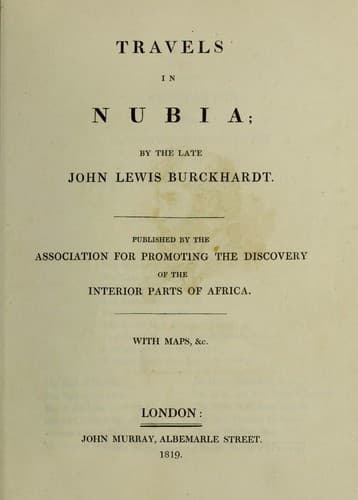
Burckhardt, John Lewis, 1784-1817; Nile River Valley -- Description and travel; Nubia -- Description and travel
The market is so crowded, and the dust and heat are so great,
during the mid-day hours, which is the favourite time for transacting
business, that I was unable to remain in the market-place many hours
together, and always left one of my companions in charge of the
little I had to sell. In different parts of the place are stationed
peasants with jars of water, which they sell to the thirsty, at the
rate of a handful of Dhourra for as much water as two persons can
drink. Several of the Fakys have water cisterns in the court-yards
of their houses, which are always kept full, and at which every one
may drink gratis. Many of them have likewise small chapels annexed
to their dwellings. There is no mosque in the whole place.
The only artizans I saw at Shendy were blacksmiths, silversmiths,
who work very coarse ornaments for the women, tanners, potters, and
carpenters. If a house is to be built, the owner, his relatives,
and slaves, with a few labourers, execute the masonry, and the
carpenter is only called in to lay the roof and make the doors. Like
the Bedouins of the desert, these Arabs are their own artizans upon
all ordinary occasions.
There are no weavers at Shendy, but all the women and grown up
children, and many of the men, are seen with a distaff constantly
in their hands, spinning cotton yarn, which they sell to the people
of Berber. The distaff, Mugzil (مغزل), resembles that used
in Egypt and Syria. Cotton is cultivated in this neighbourhood,
and is a general produce of all the countries on the banks of the
Nile, although nowhere in any great quantity, except at Damer and
about Sennaar.
Public-domain text, read in full here on John Shaqi.
Reviews
Reviews
No reviews yet
Be the first to share your thoughts on this work.
Elsewhere in the archive
Join the Discussion
Join the discussion
Sign in to leave a comment or review.
Sign InorCreate an account