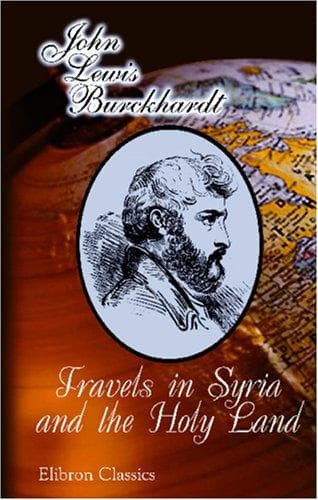
Travels in Syria and the Holy LandBurckhardt, John Lewis
History
Travels in Syria and the Holy Land
Burckhardt, John Lewis
Palestine -- Description and travel; Syria -- Description and travel
We left Howash early in the morning, and rode along the eastern
mountains, in this beautiful valley, which I can compare only to the
valley of the Bekaa between the two Libani; the Ghab, however, has this
great advantage over the Bekaa, that it is copiously watered by a large
river and many rivulets, while the latter, in summer time, has little or
no water. At half an hour from Howash we met with several fragments of
shafts of columns, on the side of an ancient paved causeway. We followed
this causeway for upwards of an hour, although in some places no remains
of it were visible; at the distance of a quarter of an hour (at the rate
of about three miles and a half an hour), from the first heap of
fragments of columns, we met with a similar heap; then at an equal
interval a third, and again a fourth; not more than four columns seemed
to have stood together in any of these places. We conjectured that this
had been a Roman road, and the columns its milliaria. The causeway was
traced here and there farther to the south, but without any appearance
of stations; it probably followed the whole length of the valley from
Apamea to Djissr Shogher. One hour and a quarter from Howash is Ayn
Houyeth [Arabic], a copious spring. The Roman road is here about sixteen
feet in breadth. To the right, in the plain, is the village of Houyeth,
and near it another village, called Ain Uktol [Arabic]. On our right was
a perpendicular rock, upon which were patches of rich verdure. Two hours
and a quarter is Ayn el Taka [Arabic], a large spring, issuing
LAKE EL TAKA.
Public-domain text, read in full here on John Shaqi.
Reviews
Reviews
No reviews yet
Be the first to share your thoughts on this work.
Elsewhere in the archive
Join the Discussion
Join the discussion
Sign in to leave a comment or review.
Sign InorCreate an account