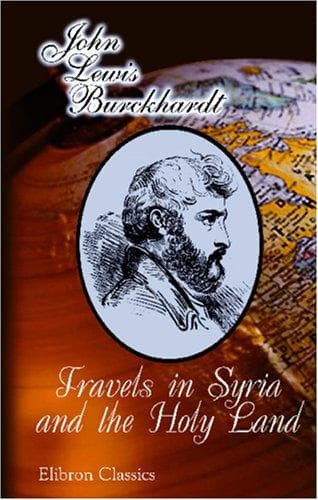
Travels in Syria and the Holy LandBurckhardt, John Lewis
History
Travels in Syria and the Holy Land
Burckhardt, John Lewis
Palestine -- Description and travel; Syria -- Description and travel
From the castle the ruins called Deir Szoleib bear W. distant about two
hours and a half. I was told that there are large buildings at that
place constructed with immense blocks of stone, and bearing infidel
inscriptions; but the natives of these countries are unable to
distinguish sculptured ornaments from letters in unknown languages, and
travellers are often deceived by reports of long inscriptions, which
prove to be nothing more than a few decorations of architecture.
February 29th.--Having been disappointed in our hopes of finding any
thing remarkable at Kalaat el Maszyad, we directed our course to
Tripoli. We began to fear that the incessant rains would make the
torrents impassable, particularly the Saroudj, which we crossed
yesterday. The Emir gave us one of his men to guide and protect us
through his territories. After travelling for an hour and a half across
the moor, along the side of the upper ridge of the mountains of Maszyad,
we arrived at the village Soeida, near to which is the Mezar Sheikh
Mohammed, with some plantations of mulberry trees. E. of it half an hour
is
NYSZAF.
[p.155]Kherbet Maynye, a ruined village, with some ancient buildings;
and in the mountain above it, the ruined castles Reszafa [Arabic], and
Kalaat el Kaher [Arabic]. There are several other ruined castles in this
district, which appear to have been all built about the twelfth century.
At two hours and a half is Beyadhein [Arabic] a village inhabited by
Turkmans; to the E. of it, about half an hour, is a Tel in the plain,
with an arched building upon it called Kubbet el Aadera, or the dome of
the Virgin Mary, reported to be the work of the Empress Helena. On the
summit of a mountain S. of the village, one hour, is the ruined castle
Barein [Arabic]. Near Beyadhein we crossed the torrent Saroudj a second
time; its different branches inundated the whole plain. Two hours and a
half is the village Kortouman [Arabic], inhabited by Turkmans, from
whence Maszyad bears N. by W. Here we passed another torrent, near a
mill, and in a storm of heavy rain and thunder reached Nyszaf, three
hours and three quarters from Maszyad, the road from Kortouman lying S.
by W. for the greater part in the plain.
Public-domain text, read in full here on John Shaqi.
Reviews
Reviews
No reviews yet
Be the first to share your thoughts on this work.
Elsewhere in the archive
Join the Discussion
Join the discussion
Sign in to leave a comment or review.
Sign InorCreate an account