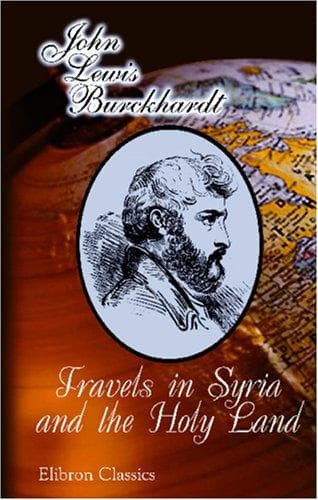
Travels in Syria and the Holy LandBurckhardt, John Lewis
History
Travels in Syria and the Holy Land
Burckhardt, John Lewis
Palestine -- Description and travel; Syria -- Description and travel
The territory of Tripoli extends over the greater part of Mount Libanus.
The Pashalik is divided into the following districts, or Mekatta
[Arabic], as they are called: viz. El Zawye [Arabic], or the lower part
of Mount Libanus to the right of the Kadisha,--Djebbet Bshirrai
[Arabic], which lies round the village of that name near the Cedars.--El
Kella [Arabic],--El Koura [Arabic], or the lower part of Mount Libanus
to the left of the Kadisha.--El Kattaa [Arabic], or the mountains
towards Batroun;--Batroun [Arabic],--Djebail [Arabic],--El Fetouh, over
Djebail, as far as Kesrouan.--Akkar [Arabic], the northern declivity of
Mount Libanus, a district governed at present by Aly Beg, a man famous
for his generosity, liberality, and knowledge of Arabian literature.--El
Shara [Arabic], also under the government of Aly Beg.--El Dhannye
[Arabic].--The mountains to the N. and N.W. of Bshirrai.--El Hermel
[Arabic], towards Baalbec, on the
[p.169] eastern declivity of the Libanus; Szaffeita [Arabic], and
Tartous [Arabic]. The greater part of the mountaineers are Christians;
in Bshirrai they are all Christians; in Akkar, Shara, and Koura, three-
fourths are Christians. The Metawelis have possessions at Djebail,
Dhannye, and Hermel. About eighty years since the latter peopled the
whole district of Bshirrai, El Zawye, Dhannye, and part of Akkar; but
the Turk and Christian inhabitants, exasperated by their vexatious
conduct, called in the Druses, and with their assistance drove out the
Metawelis. Since that period, the Druses have been masters of the whole
mountain, as well as of a part of the plain. The Emir Beshir pays to the
Pasha of Tripoli, for the Miri of the mountain, one hundred and thirty
purses, and collects for himself upwards of six hundred purses. The
duties levied upon the peasants in this district are generally
calculated by the number of Rotolas of silk which the peasant is
estimated to get yearly from his worms; the taxes on the mulberry trees
are calculated in proportion to those on the silk. The peasant who rears
silk-worms is reckoned to pay about twenty or twenty-five per cent. on
his income, while he who lives by the produce of his fields pays more
than fifty per cent.
I obtained the following information respecting the modern history of
the Pashas of Tripoli.
Fettah Pasha, of three tails, was driven out of Tripoli by the
inhabitants, about 1768, after having governed a few years. He was
succeeded by Abd-er-rahman Pasha, but the rebels still maintained their
ascendancy in the town. He had formerly been Kapydji for the Djerde or
caravan, which departs annually from Tripoli to meet the Mekka caravan
on its return. He made Mustafa, the chief of the rebels, his Touenkdji,
and submitted to his orders, till he found an opportunity of putting him
to death at Ladakie, whither he had gone to collect the Miri. The town
was at the
Public-domain text, read in full here on John Shaqi.
Reviews
Reviews
No reviews yet
Be the first to share your thoughts on this work.
Elsewhere in the archive
Join the Discussion
Join the discussion
Sign in to leave a comment or review.
Sign InorCreate an account