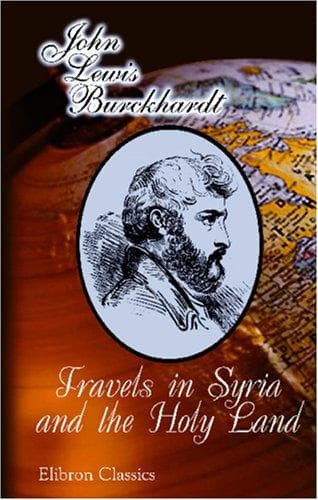
Travels in Syria and the Holy LandBurckhardt, John Lewis
History
Travels in Syria and the Holy Land
Burckhardt, John Lewis
Palestine -- Description and travel; Syria -- Description and travel
At an hour and three quarters from Kessoue is Deir Ali, to the north of
which, upon the summit of Djebel Kessoue, is situated the Mezar el
Khaledye [Arabic]; Deir Ali is a village inhabited by Druses, who keep
the Arabs in great awe, by the reputation for courage which they have
acquired upon many occasions. It seems rather extraordinary that the
Druses, the known enemies of the Mohammedan faith, should be allowed to
inhabit the country so near to the gate of the holy city, as Damascus is
called; for not only Deir Ali, but three or four villages, as Artous,
Esshera, Fye, and others, at only three hours distant from Damascus, are
for the greater part peopled by them. Numbers of them are even settled
in the town; the quarters called Bab Mesalla and El Hakle, in the
Meidhan, or suburbs of the city, contain
MERDJAN.
[p.213]more than one hundred Druse families, who are there called
Teyamene [Arabic]. In another quarter, called El Khereb, live three or
four hundred Metaweli families, or Shiytes, of the sect of Aly; of this
sect is the present Mutsellim, Aly Aga. The religious creeds of all
these people are publicly known; but the fanatism of the Damascenes,
however violent, is easily made subservient to their fears or interests;
every religious and moral duty being forgotten when the prospect of gain
or the apprehension of danger presents itself.
At three hours and a quarter from Kessoue is the village El Merdjan.
When I passed this place in 1810, I found a single Christian family in
it; I now found eight or ten families, most of them Druses, who had
emigrated hither from Shaara, a well peopled village in 1810, but now
deserted. They had brought the fertile soil round El Merdjan into
cultivation, and had this year sown eight Ghararas of wheat and barley,
or about one hundred and twenty cwt. English.[The Gharara of Damascus is
eighty Muds, at three and a half Rotola per Mud, or twenty pounds.] The
taxes paid by the village amounted to a thousand piastres, or fifty
pounds sterling, besides the tribute extorted by the Bedouins. The
vicinity of the village is watered by several springs. I was obliged to
remain at Merdjan the next day, because my mare fell ill, and was unable
to proceed. As I did not like to return to Damascus, I bought a mare of
the Sheikh of the village, a Christian of Mount Libanus, who knew me,
and who took a bill upon Damascus in payment. This mare I afterwards
bartered for a Bedouin horse.
April 23d.--I left Merdjan to examine the eastern limits of the Ledja.
We passed the Aamoud Eszoubh [Arabic], or Column of the Morning, an
insulated pillar standing in the plain; it is formed
BERAK.
Public-domain text, read in full here on John Shaqi.
Reviews
Reviews
No reviews yet
Be the first to share your thoughts on this work.
Elsewhere in the archive
Join the Discussion
Join the discussion
Sign in to leave a comment or review.
Sign InorCreate an account