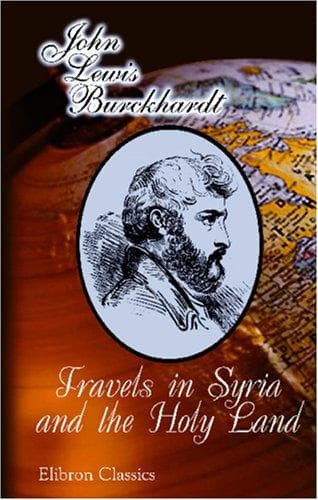
Travels in Syria and the Holy LandBurckhardt, John Lewis
History
Travels in Syria and the Holy Land
Burckhardt, John Lewis
Palestine -- Description and travel; Syria -- Description and travel
I had intended to sleep at Om Ezzeitoun, but I found the Druses very
ill-disposed towards me. It was generally reported that I had discovered
a treasure in 1810 at Shohba, near this place, and it was supposed that
I had now returned to carry off what I had then left behind. I had to
combat against this story at almost every place, but I was nowhere so
rudely received as at this village, where I escaped ill treatment only
by assuming a very imposing air, and threatening with many oaths, that
if I lost a single hair of my beard, the Pasha would levy an avania of
many purses on the village. I had with me an old passport from Soleiman
Pasha, who, though no longer governor of Damascus, had been charged pro
tempore with the government till the arrival of the new Pasha, who was
expected from Constantinople. Soleiman had retired to his former
government at Acre, but his Mutsellim at Damascus very kindly granted me
strong letters of recommendation to all the authorities of the country,
which were of great use to me in the course of my journey.
I left Om Ezzeitoun late in the evening, to proceed toward the mountain
of Haouran. Our road lay on the N. side of Tel Shiehhan,
BEREIT.
[p.221]close to which runs the Ledja; and the Wady Lowa descends the
mountain on the west side of it. We proceeded in the direction of
Soueida, and in an hour and a quarter from the village stopped, after
sunset, at an encampment of the Djebel Haouran Arabs. My companion, and
a guide whom I had engaged at Om Ezzeitoun, persuaded me to appear
before the Arabs as a soldier belonging to the government, in order to
get a good supper, of which we were in great want, that of the preceding
night, at the saltpetre works, having consisted of only a handful of dry
biscuit. We were served with a dish of rice boiled in sour milk, and
were much amused by the sports and songs of the young girls of the
tribe, which they continued in the moonlight till near midnight. One of
the young men had just returned to the encampment, who had been taken
prisoner by the Aeneze during a nightly predatory expedition. He showed
us the marks of his fetters, and enlarged upon the mode of treating the
Rabiat, or prisoner, among the Aeneze. A friend had paid thirty camels
for his liberation. In spring the Arabs of the Djebel Haouran and the
Ledja take advantage of the approach of the Aeneze, to plunder daily
among their enemies; they are better acquainted with the ground than the
latter, a part of whose horses and cattle are every spring carried off
by these daring mountaineers.
Public-domain text, read in full here on John Shaqi.
Reviews
Reviews
No reviews yet
Be the first to share your thoughts on this work.
Elsewhere in the archive
Join the Discussion
Join the discussion
Sign in to leave a comment or review.
Sign InorCreate an account