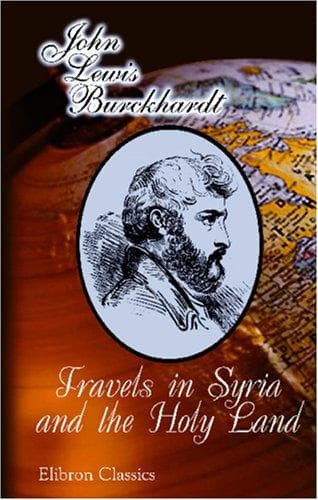
Travels in Syria and the Holy LandBurckhardt, John Lewis
History
Travels in Syria and the Holy Land
Burckhardt, John Lewis
Palestine -- Description and travel; Syria -- Description and travel
The pilgrim caravan to Mekka collects at the Mezareib, where the Pasha,
or Emir el Hadj, remains encamped for ten days, in order to collect the
stragglers, and to pay to the different Arab tribes the accustomed
tribute for the passage of the caravan through the desert. The
warehouses of the castle are annually well stocked with wheat, barley,
biscuit, rice, tobacco, tent and horse equipage, camel saddles, ropes,
ammunition, &c. each of which has its particular warehouse. These stores
are exclusively for the Pasha's suite, and for the army which
accompanies the Hadj; and are chiefly consumed on their return. It is
only in cases of great abundance, and by particular favour, that the
Pasha permits any articles to be sold to the pilgrims. At every station,
as far as Medina, is a castle, but generally smaller than this, filled
with similar stores.
[p.243]The Haouran alone is required to deliver every year into the
store houses of the Mezareib, two thousand Gharara of barley, or about
twenty or twenty-five thousand cwt. English. The town of Damascus has
been fed for the last three months with the biscuit stored in the
Mezareib for the Hadj.
As far as the Pasha was concerned, the affairs of the great Caravan were
generally well managed; but there still reigned a great want of economy,
and the expenses of the Hadjis increased every year. Of late years, the
hire of a single camel from Damascus to Mekka has been seven hundred and
fifty piastres; as much, and often more, was to be paid on coming back;
and the expenses on the road, and at Mekka, amounted at least to one
thousand piastres, so that in the most humble way, the journey could not
be performed at less than two thousand five hundred piastres, or £125.
sterling. A camel with a litter cost fifteen hundred in going, and as
much in coming back. Of the whole caravan not above one-tenth part were
real pilgrims, the rest consisted of soldiers, the servants of soldiers,
people attached to the Pasha's suite, merchants, pedlars, camel-drivers,
coffee and pipe waiters, a swarm of Bedouins, together with several
tents of public women from Damascus, who were so far encouraged, that,
whenever they were unable to obtain from their lovers the daily food for
their horses or mules, they obtained a supply from the Pasha's stores.
The greater part of the pilgrims usually contract for the journey with
one of the great undertakers, or Mekouam [Arabic], as they are called;
this agreement is only for a beast of transport and for water; as to
eating, the pilgrims generally mess together at their own expense, in
bodies of about half a dozen. The Mekouam, on agreeing to furnish a
beast of burthen, are bound to replace whatever may die on the road, and
are therefore obliged to carry with them at least one unloaded camel for
every loaded one. It is a general
Public-domain text, read in full here on John Shaqi.
Reviews
Reviews
No reviews yet
Be the first to share your thoughts on this work.
Elsewhere in the archive
Join the Discussion
Join the discussion
Sign in to leave a comment or review.
Sign InorCreate an account