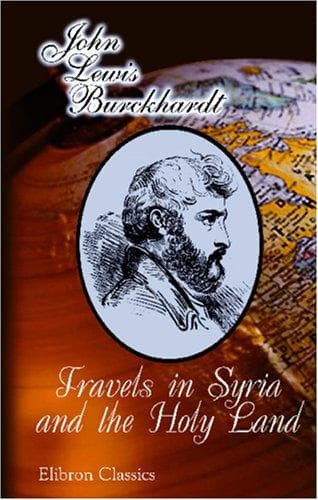
Travels in Syria and the Holy LandBurckhardt, John Lewis
History
Travels in Syria and the Holy Land
Burckhardt, John Lewis
Palestine -- Description and travel; Syria -- Description and travel
[p.281]Beyond the fields of Feik, the district of Djolan begins, the
southern limits of which are the Wady Hamy Sakker, and the Sheriat.
Djolan appears to be the same name as the Greek Gaulanitis; but its
present limits do not quite correspond with those of the ancient
province, which was confined to a narrow strip of land along the lake,
and the eastern shore of the Jordan. The territory of Feik must have
formed part of Hippene; the mountain in front of it was mount Hippos,
and the district of Argob appears to have been that part of the plain
(making part of Djolan), which extends from Feik northwards for three or
four hours, and which is enclosed on the east by the Djebel Heish, and
on the west by the descent leading down to the banks of the lake.
Half an hour from Feik we passed, on our left, a heap of ruins called
Radjam el Abhar [Arabic]. To the S.E. at about one hour distant, is the
village Djeibein [Arabic]; to the left, at three quarters of an hour, is
the ruined village El Aal [Arabic], on the side of the Wady Semak
[Arabic], which descended from the Djebel Heish: there is a rivulet of
spring-water in the Wady, which empties itself into the lake near the
ruined city of Medjeifera [Arabic], in this part the Wady is full of
reeds, of which the people make mats. On the other side of the Wady,
about half an hour distant from it, upon a Tel, is the ruined city
called Kaszr Berdoweil [Arabic] (Castle of Baldwin). The plain here is
wholly uncultivated, and is overgrown with a wild herb called Khob
[Arabic], which camels and cows feed upon. At one hour and three
quarters is a Birket of rain water, called Nam [Arabic], with a spring
near it. At two hours and a quarter are the extensive ruins of a city,
called Khastein [Arabic], built with the black stone of the country, but
preserving no remains of any considerable building. Two hours and three
quarters, on our left, is Tel Zeky [Arabic], to the left of which, about
one hour and a half, is the southern extremity of the Djebel Heish,
where stands a Tel
TSEIL.
[p.282]called El Faras. The Djebel Heish is separated from the plain bya
stony district, of one hour in breadth, where the Arabs of the country
often take refuge from the extortions of the Pasha. In three hours we
passed Wady Moakkar [Arabic], flowing from the mountain into the
Sheriat. Here the direction of our road was E.S.E. The Arab who
accompanied me presented me with a fruit which grows wild in these
parts, and is unknown in the northern parts of Syria, and even at
Damascus; it is of the size of a small egg, of the colour of the Tomato
or love-apple, of a sweet agreeable taste, and full of juice. It grows
upon a shrub about six inches high, which I did not see, but was told
that its roots were three or four feet in length, and presented the
figure of a man in all its parts. The fruit is called by the Arabs
Djerabouh [Arabic].
Public-domain text, read in full here on John Shaqi.
Reviews
Reviews
No reviews yet
Be the first to share your thoughts on this work.
Elsewhere in the archive
Join the Discussion
Join the discussion
Sign in to leave a comment or review.
Sign InorCreate an account