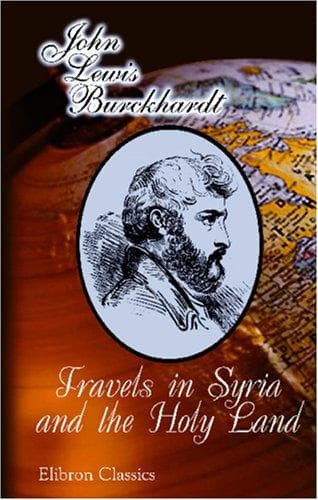
Travels in Syria and the Holy LandBurckhardt, John Lewis
History
Travels in Syria and the Holy Land
Burckhardt, John Lewis
Palestine -- Description and travel; Syria -- Description and travel
[p.326] missionaries generally realise some property, as they are
allowed ten per cent. upon all alms collected, besides their travelling
expenses. The Jewish devotees pass the whole day in the schools or the
synagogue, reciting the Old Testament and the Talmud, both of which many
of them know entirely by heart. They all write Hebrew; but I did not see
any fine hand-writing amongst them; their learning, seems to be on the
same level as that of the Turks, among whom an Olema thinks he has
attained the pinnacle of knowledge if he can recite all the Koran
together with some thousand of Hadeath, or sentences of the Prophet, and
traditions concerning him; but neither Jews, nor Turks, nor Christians,
in these countries, have the slightest idea of that criticism, which
might guide them to a rational explanation or emendation of their sacred
books. It was in vain that I put questions to several of the first
Rabbins, concerning the desert in which the children of Israel sojourned
for forty years; I found that my own scanty knowledge of the geography
of Palestine, and of its partition amongst the twelve tribes, was
superior to theirs.
There are some beautiful copies of the books of Moses in the Syrian
synagogue, written upon a long roll of leather, not parchment, but no
one could tell me when or where they were made; I suspect, however, that
they came from Bagdad, where the best Hebrew scribes live, and of whose
writings I had seen many fine specimens at Aleppo and Damascus. The
libraries of the two schools at Tiberias are moderately stocked with
Hebrew books, most of which have been printed at Vienna and Venice.
Except some copies of the Old Testament and the Talmud, they have no
manuscripts.
They observe a singular custom here in praying; while the Rabbin recites
the Psalms of David, or the prayers extracted from them, the
congregation frequently imitate by their voice or gestures,
[p.327] the meaning of some remarkable passages; for example, when the
Rabbin pronounces the words, Praise the Lord with the sound of the
trumpet, they imitate the sound of the trumpet through their closed
fists. When a horrible tempest occurs, they puff and blow to represent
a storm; or should he mention the cries of the righteous in distress,
they all set up a loud screaming; and it not unfrequently happens that
while some are still blowing the storm, others have already begun the
cries of the righteous, thus forming a concert which it is difficult for
any but a zealous Hebrew to hear with gravity.
Public-domain text, read in full here on John Shaqi.
Reviews
Reviews
No reviews yet
Be the first to share your thoughts on this work.
Elsewhere in the archive
Join the Discussion
Join the discussion
Sign in to leave a comment or review.
Sign InorCreate an account