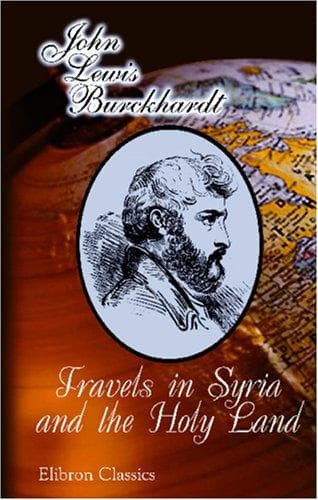
Travels in Syria and the Holy LandBurckhardt, John Lewis
History
Travels in Syria and the Holy Land
Burckhardt, John Lewis
Palestine -- Description and travel; Syria -- Description and travel
[p.345] The river, where we passed it, was about eighty paces broad, and
about three feet deep; this, it must be recollected, was in the midst of
summer. In the winter it inundates the plain in the bottom of the narrow
valley, but never rises to the level of the upper plain of the Ghor,
which is at least forty feet above the level of the river. The river is
fordable in many places during summer, but the few spots where it may be
crossed in the rainy season are known only to the Arabs.
After passing the river we continued our route close to the foot of the
eastern mountain. In half an hour from the ford we crossed Wady Mous
(Arabic), coming from the mountains of Adjeloun. In one hour and a
quarter we passed Wady Yabes, and near it, the Mezar, or saints tomb
called Sherhabeib (Arabic). In two hours we came to a stony and hilly
district, intersected by several deep but dry Wadys, called Korn el
Hemar (Arabic), the Asss Horn. Our direction was alternately S. and S.
by W. Here the Jordan returns to the western side of the valley. The
Korn el Hemar
ABOU OBEIDA
[p.346] projects into the Ghor about four miles, so that when seen from
the north the valley seems to be completely shut up by these hills. From
thence a fertile tract commences, overgrown with many Bouttom (Arabic)
or wild pistachio trees. Large tracts of ground were burnt, owing
probably to the negligence of travellers who had set the dry grass on
fire. At the end of six hours, and late at night, we passed to the
right, the ruins of an ancient city standing on the declivity of the
mountain and still bearing its original name Amata (Arabic). My
companions told me that several columns remain standing, and also some
large buildings. A small rivulet here descends into the plain. In six
hours and a half we reached the Mezar Abou Obeida (Arabic), where we
rested for two hours. The tomb of the Sheikh is surrounded by a few
peasants houses; but there are no inhabitants at present, except the
keeper of the tomb and his wife, who live upon the charity of the
Bedouins. It appears from the account given by the great Barbary
traveller, Ibn Batouta, that in the sixteenth century this part of the
Ghor was well cultivated, and full of villages.
Public-domain text, read in full here on John Shaqi.
Reviews
Reviews
No reviews yet
Be the first to share your thoughts on this work.
Elsewhere in the archive
Join the Discussion
Join the discussion
Sign in to leave a comment or review.
Sign InorCreate an account