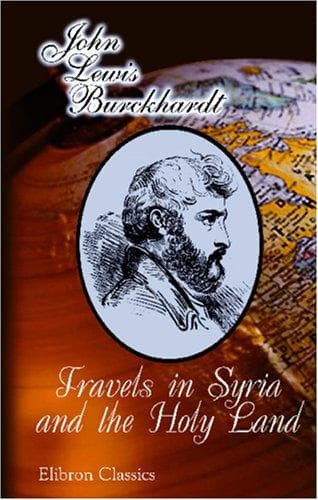
Travels in Syria and the Holy LandBurckhardt, John Lewis
History
Travels in Syria and the Holy Land
Burckhardt, John Lewis
Palestine -- Description and travel; Syria -- Description and travel
Kerek is the see of a Greek bishop, who generally resides at Jerusalem.
The diocese is called Battra (Arabic) in Arabic, and [Greek] in Greek;
and it is the general opinion among the clergy of Jerusalem, that Kerek
is the ancient Petra;[The Greek bishops belonging to the Patriarchal see
of Jerusalem are: 1. Kaisaryet Filistin; 2. Bysan: 3. Battra; 4. Akka;
5. Bethlehem; 6. Nazareth. The Greek bishops in partibus (Arabic) are;
1. Lyd; 2. Gaza; 3. Syna; 4. Yaffa; 5. Nablous; 6. Shabashye; 7. Tor
Thabour: 8. Djebel Adjeloun.] but it will be seen in the sequel of this
journal that there is good reason to think they are mistaken; Kerek
therefore is probably the Charax Omanorum of Pliny. The bishops revenue
is about six pounds sterling per annum; he visits his diocese every five
or six years. During my stay, a Greek priest arrived from Jerusalem, to
collect for his convent, which had been at a great expense in rebuilding
the church of the Holy Sepulchre. The Greeks delivered to him in sheep
to the value of about fifteen pounds sterling.
The Kerekein cultivate the plains in the neighbouring mountains and feed
their cattle on the uncultivated parts. One-third of the people remain
encamped the whole year at two or three hours distant from the town, to
superintend the cattle; the rest encamp in the harvest time only. During
the latter period the Christians have two large camps or Douars, and the
Turks five. Here they
[p.388] live like Bedouins, whom they exactly resemble, in dress, food,
and language. The produce of their fields is purchased by the Bedouins,
or exchanged for cattle. The only other commercial intercourse carried
on by them is with Jerusalem, for which place a caravan departs every
two months, travelling either by the route round the southern extremity
of the Dead sea, which takes three days and a half, or by crossing the
Jordan, a journey of three days. At Jerusalem they sell their sheep and
goats, a few mules, of which they have an excellent breed, hides, wool,
and a little Fowa or madder (Rubia tinctorum), which they cultivate in
small quantities; in return they take coffee, rice, tobacco, and all
kinds of articles of dress, and of household furniture. This journey,
however, is undertaken by few of the natives of Kerek, the trade being
almost wholly in the hands of a few merchants of Hebron, who keep shops
at Kerek, and thus derive large profits from the indolence or ignorance
of the Kerekein. I have seen the most common articles sold at two
hundred per cent. profit. The trade is carried on chiefly by barter: and
every thing is valued in measures of corn, this being the readiest
representative of exchange in the possession of the towns-people; hence
the merchants, make their returns chiefly in corn and partly in wool.
The only artizans in Kerek who keep shops are a blacksmith, a shoemaker,
and a silversmith. When the Mekka caravan passes, the Kerekein sell
provisions of all kinds to the Hadj, which they meet at the castle of
Public-domain text, read in full here on John Shaqi.
Reviews
Reviews
No reviews yet
Be the first to share your thoughts on this work.
Elsewhere in the archive
Join the Discussion
Join the discussion
Sign in to leave a comment or review.
Sign InorCreate an account