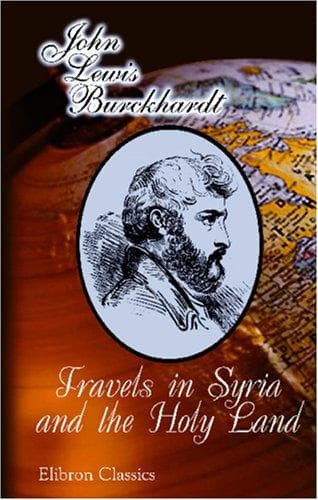
Travels in Syria and the Holy LandBurckhardt, John Lewis
History
Travels in Syria and the Holy Land
Burckhardt, John Lewis
Palestine -- Description and travel; Syria -- Description and travel
Several Wadys descend from the mountains of Kerek into the plain on the
shore of the Dead sea, and are there lost, either in the sands or in the
fields of the peasants who cultivate the plain, none of them reaching
the lake itself in the summer. To the S. of Modjeb is the Seyl Djerra
(Arabic), and farther south, Wady Beni Hammad (Arabic). In the valley of
this river, perhaps the Zared of Scripture, are hot-wells, with some
ruined buildings near them, about five hours from Kerek, in a northern
direction. Next follow Seyl el Kerek, Wady el Draah (Arabic), Seyl Assal
(Arabic), perhaps Assan, which rises nearer Ketherabba; El Nemeyra
(Arabic), coming from Oerak; Wady Khanzyre (Arabic), and El Ahhsa, a
river which divides the territory of Kerek from the district to the S.
of it, called El Djebel.
Not having had an opportunity of descending to the borders of the Dead
sea, I shall subjoin here a few notes which I collected from the people
of Kerek. I have since been informed that M. Seetzen, the most
indefatigable traveller that ever visited Syria, has made the complete
tour of the Dead sea; I doubt not that he has made many interesting
discoveries in natural history.
The mountains which inclose the Ghor, or valley of the Jordan, open
considerably at the northern extremity of the Dead sea, and encompassing
it on the W. and E. sides approach again at its S. extremity, leaving
only a narrow plain between them. The plain on the west side, between
the sea and the mountains, is covered with sand, and is unfit for
cultivation; but on the E. side, and especially towards the S.
extremity, where it continues to bear the appellation of El Ghor
(Arabic), the plain is in many places very fertile. Its breadth
[p.391] varies from one to four and five miles; it is covered with
forests, in the midst of which the miserable peasants build their huts
of rushes, and cultivate their Dhourra and tobacco fields. These
peasants are called El Ghowárene (Arabic), and amount to about three
hundred families; they live very poorly, owing to the continual
exactions of the neighbouring Bedouins, who descend in winter from the
mountains of Belka and Kerek, and pasture their cattle amidst the
fields. The heat of the climate of this low valley, during the summer,
renders it almost uninhabitable; the people then go nearly naked; but
their low huts, instead of affording shelter from the mid-day heat
rather increase it. At this period violent intermittent fevers prevail,
to which, however, they are so much accustomed, that they labour in the
fields during the intervals of the paroxysms of the disease.
Public-domain text, read in full here on John Shaqi.
Reviews
Reviews
No reviews yet
Be the first to share your thoughts on this work.
Elsewhere in the archive
Join the Discussion
Join the discussion
Sign in to leave a comment or review.
Sign InorCreate an account