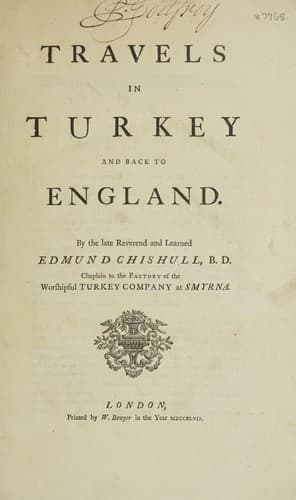
Travels in Turkey and back to EnglandChishull, Edmund
History
Travels in Turkey and back to England
Chishull, Edmund
Turkey -- Description and travel -- Early works to 1800
Your great goodness will excuse the tardiness of this letter, when I
assure you, that I have been long ambitious of collecting any thing, that
might deserve your notice; tho hitherto I have been successless in that
desire. Many things indeed have occurred observable to me; but I could
not hope at the same time, that they might appear such to you. For it is
common with unexperienced travelers to be transported with pleasure and
admiration, when their accounts are not able to raise the same affections
in their freinds; either because they converse with men of better
judgment, or because the most valuable relations must needs be heard with
a greater coldness, than the things were seen. But notwithstanding these
discouragements, I have lately looked back upon my _Journal_, to see if
any thing might there appear remarkable at this distance; and tho a short
voyage by sea must be barren of all real curiosity, yet for the subject
of this letter I shall now trouble you with some of the things, which I
observed at _Cadiz_, _Messina_, and _Milo_, the three only places, where
we touched in our passage hither.
In _Cadiz_, as in most other parts of the Spanish dominions, there is
nothing very curious, but in their churches or convents; and this, when
once seen, is to be deplored, rather than admired. For when you first
come into the town, you are not so much struck with a face of religion,
as with the notion of a certain politic game, where the priests are
soon discovered to be the only winners. Since in the whole place there
is nothing fat and well favoured, but the clergy. The rest of the
inhabitants appear meagre, wan, and melancholy, being mostly employed
either in repairing to mass, or returning from it; sometimes counting
their beads, and at other times perhaps lugging an heavy Saint in their
arms. And therefore, were they not supported under this condition by a
certain natural pride, which is fed partly with the real history of their
former state, and partly with a romantic imagination of their present
grandeur; they would soon become so sensible of their slavish poverty and
superstition, as either to break their own hearts, or that yoke, which
oppresses them.
Public-domain text, read in full here on John Shaqi.
Reviews
Reviews
No reviews yet
Be the first to share your thoughts on this work.
Elsewhere in the archive
Join the Discussion
Join the discussion
Sign in to leave a comment or review.
Sign InorCreate an account