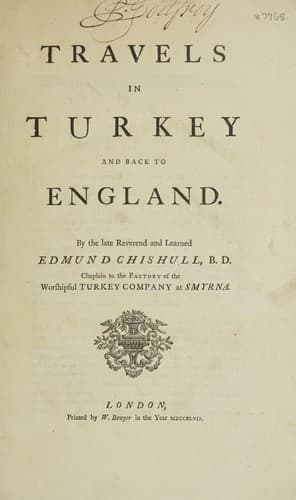
Travels in Turkey and back to EnglandChishull, Edmund
History
Travels in Turkey and back to England
Chishull, Edmund
Turkey -- Description and travel -- Early works to 1800
[21] This _Statius Quadratus_ was that very proconsul, in whose presence,
and by whose authority, _St. Polycarp_, bishop of _Smyrna_, was burnt
alive in the amphitheatre of that city. His name is falsely written
Τάτιος Κ. in the _Alexandrian Chronicle_, and Στράτιος in the _Epistle of
the church of Smyrna_. But this stone confirms that correction, which has
been made by bishop _Pearson_ and _Valesius_. It likewise favours that
learned argument maintained by bishop _Pearson_, Dissert. ii. cap. xvi,
xvii. pag. 291, by which he places this proconsulship and the martyrdom
of _St. Polycarp_ in the tenth year of _Antoninus Pius_, _A. C._ 147.
For in the fourth year of _M. Antoninus_, to which the _Alexandrian
Chronicle_ refers it; as also in the year 167, to which it is referred
by _Eusebius_ and _Valesius_; there were two _Caesars_, concerning whom
_Eutropius_ says: _Tunc primum Rom. respublica duobus aequo jure imperium
administrantibus paruit, cum usque ad eum singulos semper habuisset
Augustos._ Lib. viii. cap. 5. But this inscription mentions only one
_Caesar_, in the singular number. And as for that _Quadratus_, whom
_Bucherius_ and _Usserius_ will have proconsul in _Asia_ in the year
169, his name was not _Statius_, but _T. Numidius_. See also mention
of _Quadratus_ in _Aristidis Orat. Genethliac. in Apellam_; and in his
_Sermon. Sacror._ iv.
[22] Καὶ γάρ τ’ ἠΰκομος Νιόβη ἐμνήσατο σίτου, etc.
Νῦν δέ που ἐν πέτρῃσιν, ἐν οὔρεσιν οἰοπόλοισιν
Ἐν Σιπύλῳ, ὅθι φασὶ θεάων ἔμμεναι εὐνὰς
Νυμφάων, αἵτ’ ἀμφ’ Ἀχελώϊον ἐῤῥώσαντο,
Ἔνθα, λίθος πὲρ ἐοῦσα θεῶν ἐκ κήδεα πέσσει.
_Hom. Iliad._ ω. 602. On which passage the _Scholia_, usually ascribed to
_Didymus_, have the following remark: Θρηνοῦσαν οὖν τὴν Νιόβην ἀφάτως τὸ
τοιοῦτον δυστύχημα, Ζεὺς ἐλεήσας εἰς λίθον μετέβαλεν, ὃς καὶ μέχρι νῦν
ἐν Σιπύλῳ τῆς Φρυγίας ὁρᾶται παρὰ πάντων πηγὰς δακρύων προϊέμενος. And
_Pausanias_, _Attic._ _Lib._ i. _cap._ 21. says: Ταύτην τὴν Νιόβην καὶ
αὐτὸς εἶδον ἀνελθὼν ἐς τὸν Σίπυλον τὸ ὄρος. Ἥδε πλησίον μὲν πέτρα καὶ
κρημνός ἐστιν, οὐδὲν παρόντι σχῆμα παρεχόμενος γυναικὸς, οὔτε ἄλλως, οὔτε
πενθούσης· εἰ δέ γε ποῤῥωτέρω γένοιο, δεδακρυμένην δόξεις ὁρᾷν καὶ κατηφῆ
γυναῖκα.
[23] Plin. Lib. v. cap. 29. _A Smyrna Hermus amnis campos facit, et
nomini suo adoptat; oritur juxta Dorglaeum Phrygiae civitatem, multosque
colligit fluvios, inter quos Hyllum et Cryon._
[24] See mention of these by _Herodian_, under the name of πολυάνδρια, in
his description of that massacre of the Alexandrians by Caracalla, _Lib._
iv. _cap._ 17. _edit. Oxon._
[25] The sense of the word _barrows_ or _burroughs_ is by _Verstegan_
deduced from _burying_, and therefore well answers the Greek πολυάνδρια.
Chap. vii. p. 211.
[26] Thus Lucan, _Stetit aggere fultus Cespitis_. Lib. v. ℣. 316.
And _Tacitus_, Annal. L. i. cap. 17. _Congerunt cespites._ See _Lipsii
not._
Public-domain text, read in full here on John Shaqi.
Reviews
Reviews
No reviews yet
Be the first to share your thoughts on this work.
Elsewhere in the archive
Join the Discussion
Join the discussion
Sign in to leave a comment or review.
Sign InorCreate an account