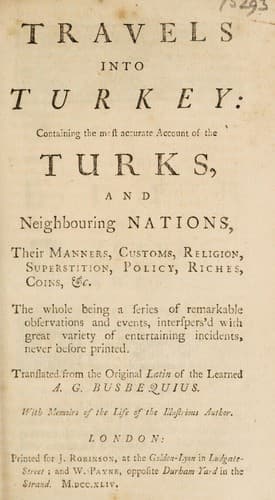
Travels into Turkey: Containing the most accurate account of the Turks, and neighbouring nations, their manners, customs, religion, superstition, policy, riches, coins, &c.Busbecq, Ogier Ghislain de
History
Travels into Turkey: Containing the most accurate account of the Turks, and neighbouring nations, their manners, customs, religion, superstition, policy, riches, coins, &c.
Busbecq, Ogier Ghislain de
Turkey -- Description and travel -- Early works to 1800
by frequent Commerce with that People, he had got much of their Language,
and seemed to forget his own. Being asked concerning the Nature and
Manners of that People, he answered very pertinently, that they were a
warlike Nation, that inhabited many Towns thereabouts, from whence the
Cham of _Tartary_, when he pleased, used to draw forth 800 Musketeers,
the chief Prop of his Army. Their chief Cities were two, one called
_Mancup_ the other _Scivarin_. He added much more concerning the Tartars
and their Barbarity; yet he confessed that there was some very ingenious
Men amongst them. If you asked of the highest Affairs, they would answer
briefly, yet very much to the purpose. Insomuch, that the _Turks_ said
frequently and justly of them, that _other Nations had their Learning
in their Books, but the ~Tartars~ had eaten their Books, and had their
Wisdom in their Breasts, from whence they could draw it out as they had
occasion, as Divine Oracles._
They are slovenly in their Deportment; for, if you set any Soop before
them, they eat it not with a Spoon, but with the hollow of their Hands.
Their Meat is Horse-flesh; not roasted, but heated under the Saddles of
their Horses, to which Hunger was their best Sauce.
Their Prince is served in Silver, his first and last Dish being a Horse’s
Head, as Butter is served up first and last with us. He repeated many
_German_ Words, amongst others, which were unintelligible to us; perhaps
his Memory fail’d him, so that he mix’d home-bred and foreign Words
together; to every Word he added the Article _Tho_ or _The_. The Words
which were ours, or little different from them, were these:
Broe, _Bread_.
Plut, _Blood_.
Stul, _a Stool or Seat_.
Hus, _a House_.
Wingart, _a Vine_.
Reghen, _Rain_.
Bruder, _Brother_.
Schwester, _Sister_.
Alt, _Old Man_.
Wintch, _Wind_.
Silvir, _Silver_.
Goltz, _Gold_.
Kor, _Wheat_.
Salt, _Salt_.
Fisct, _Fish_.
Hoef, _the Head_.
Thurn, _a Gate_.
Stern, _a Star_.
Sune, _the Sun_.
Mine, _the Moon_.
Tag, _a Day_.
Oeghene, _the Eyes_.
Bars, _a Beard_.
Handa, _the Hands_.
Boga, _a Bow_.
Miera, _an Ant_.
Rinck, _or_ Ringo, _a Ring_.
Brunna, _a Fountain_.
Waghen, _a Waggon or Coach_.
Apel, _an Apple_.
Schieten _to shoot an Arrow_.
Schlipen, _to Sleep_.
Kommen, _to come_.
Singhen, _to Sing_.
Lachen, _to Laugh_.
Criten, _to Weep_.
Geen, _to go_.
Breen, _to roast_.
Schwalch, _Death_.
_Knauen Tag_ was _Good-day_ with him; _Knauen_ was _Good_; and several
such Words he used, not well agreeing with ours, as,
Public-domain text, read in full here on John Shaqi.
Reviews
Reviews
No reviews yet
Be the first to share your thoughts on this work.
Elsewhere in the archive
Join the Discussion
Join the discussion
Sign in to leave a comment or review.
Sign InorCreate an account