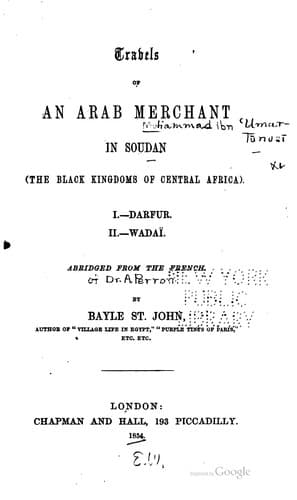
Travels of an Arab merchant in Soudan (the Black Kingdoms of Central Africa)Tūnisī, Muḥammad ibn ʻUmar
History
Travels of an Arab merchant in Soudan (the Black Kingdoms of Central Africa)
Tūnisī, Muḥammad ibn ʻUmar
Darfur (Sudan) -- Description and travel; Wadai (Sultanate) -- Description and travel
Before leaving Bagirmeh, Saboun had placed upon the throne one of
the younger sons of the former Sultan. But the Wadaïan army had no
sooner departed than Chigama, the eldest son, who had fled, came
back with the Fecha and dethroned the young prince, and, throwing
him into prison, caused him to be starved to death. This led to a
new war. Ajmain was sent once more to reduce the country. Chigama
was made prisoner; but at last was made Sultan by Saboun himself,
and reigned successfully.
Some time afterwards Saboun undertook an expedition against
Dar-Tamah. His army was at first repulsed; but on a second attack
the mountain was taken, and the whole of the population put to
the sword. My father, with a little troop consisting of twenty-two
Magrebyns, armed with guns, was of great use in this action. The
Sultan of Darfur was angry at this aggression; but took no effectual
means to protect his vassal of Tamah, who finally agreed to pay
tribute to Wadaï. Having finished his wars, Saboun busied himself
with the internal affairs of his country, and did all he could to
make them prosper. One day there was presented to him a Magrebyn,
belonging to the Bedawins dependent on the regency of Tripoli;
he was accompanied by several members of the tribe of Bidegat,
a non-Arab tribe established to the north of Wadaï, who related
that this Bedawin had lost his way in the sands, and had been
found by them dying of thirst. They had given him water to drink,
and having kept and fed him for a month, had brought him to Warah
to present him to the Sultan.
Saboun said to the strange Bedawin, “From whence dost thou come?”
“I belong,” he replied, “to the Wallad-Ali, a tribe
neighbouring to Barca. We started about fifty Arab horsemen in the
direction of Soudan, hoping to make a profitable excursion. We lost
our road, and at length our supply of water was exhausted. Three of
us, of which I was one, went out in search of a well. I missed my two
companions, and wandered I knew not whither. At length my horse broke
down, and I abandoned it and proceeded on foot during three whole
days. On the fourth the heat overcame me; I was dying of thirst;
and if God had not sent me these men I should have perished.”
“How many days didst thou remain without tasting water?” inquired
the Sultan.
“Six days without a single drop.”
These words astonished the audience, and some believed, whilst
others disbelieved.
It was about this time that I came to Wadaï, for the Sultan of
Darfur had delivered me from my prison, and I often saw this
Bedawin, who was named Ali. He related to me his adventures,
without contradicting himself once. Saboun made him many presents,
and placed under his orders ten slaves, that they might learn the
use of fire-arms. But Ali used often to say,—“If the Sultan,
instead of making me teach his slaves how to shoot, would confide to
me a caravan, and allow me to return to my tribe by the direct road,
a great advantage would result to the king and to the country.”
Public-domain text, read in full here on John Shaqi.
Reviews
Reviews
No reviews yet
Be the first to share your thoughts on this work.
Elsewhere in the archive
Join the Discussion
Join the discussion
Sign in to leave a comment or review.
Sign InorCreate an account