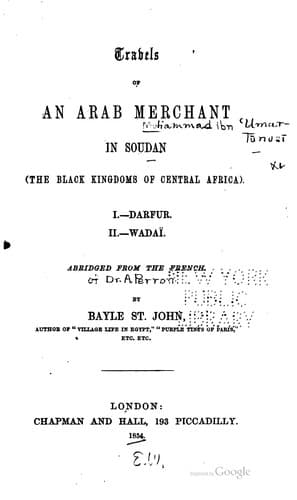
Travels of an Arab merchant in Soudan (the Black Kingdoms of Central Africa)Tūnisī, Muḥammad ibn ʻUmar
History
Travels of an Arab merchant in Soudan (the Black Kingdoms of Central Africa)
Tūnisī, Muḥammad ibn ʻUmar
Darfur (Sudan) -- Description and travel; Wadai (Sultanate) -- Description and travel
I shall here make some observations on the climate of Wadaï. Wind,
storms, thunder, and lightning, are very frequent there at the
time of the Roushach. Their violence is such, especially during
the first days of autumn, that it is almost impossible to describe
their effects. During the whole time that I remained in the country
I scarcely ever saw rain that was not preceded by a great wind
that darkened the atmosphere. These storms generally advance from
the east, and, passing over Gauz, or sandy plains, raise immense
whirlwinds of dust, and carry them to a great distance. At the
commencement of the storm the horizon is wrapped in clouds, either
black or dun red. Presently the thunder bursts forth with terrific
rolls. The people, stricken with fear, run to hide themselves. The
shepherds hastily gather together their flocks and urge them towards
the villages. Those who are working in the fields hasten to the
nearest shelter, or run wildly towards the villages. The traveller
seeks the first refuge he can find, for, if he is found abroad,
there is peril. The storm, like a haughty and terrible conqueror
at the head of his black warriors, strikes and shatters whatever it
meets with. Isolated trees are often torn up by the roots, crazy huts
are borne away, and old enclosures beaten to the ground. Even the
beasts instinctively take to flight. The whirlwinds come laden with
sand and gravel, that strike people down as if hurled from a sling.
When I first went to Darfur, on perceiving afar off these immense
whirlwinds, I expected great clouds and showers to follow, but I
was soon undeceived. These dusty masses are seldom brought by south
or west winds. They are often the effects of violent gusts, without
rain or thunder, and for this reason are the more dangerous, for the
rain soon beats down the dust and sand, and restores tranquillity to
the air. Sometimes, during a whole month, these violent burrascos
blow every day, beginning in the afternoon. Generally, in the last
days of autumn, they are entirely without rain. When they happen
at night, they are commonly accompanied by frightful showers and
thunder-claps. The lightning falls, setting fire to villages,
and dashing trees to pieces. Mischief is announced by terrible
detonations, accompanied by long trains of fire descending from the
clouds. Many Wadaïans and Forians have assured me that they have
dug pits in the earth, at the place where the thunder has fallen,
and have found substances resembling ferruginous scoriæ. In the
countries of Soudan where I have travelled the thunder is much
louder and more terrible than in Egypt. I do not know what is the
physical reason of this difference.
Public-domain text, read in full here on John Shaqi.
Reviews
Reviews
No reviews yet
Be the first to share your thoughts on this work.
Elsewhere in the archive
Join the Discussion
Join the discussion
Sign in to leave a comment or review.
Sign InorCreate an account