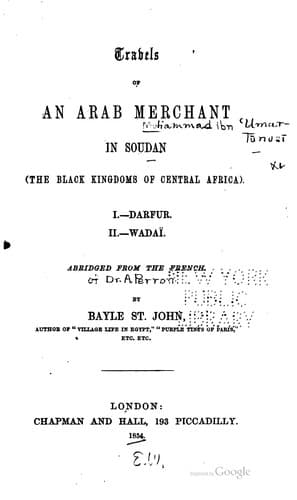
Travels of an Arab merchant in Soudan (the Black Kingdoms of Central Africa)Tūnisī, Muḥammad ibn ʻUmar
History
Travels of an Arab merchant in Soudan (the Black Kingdoms of Central Africa)
Tūnisī, Muḥammad ibn ʻUmar
Darfur (Sudan) -- Description and travel; Wadai (Sultanate) -- Description and travel
The heads are of the same form as
those of the lances, and are often so slightly fixed to the reed
that they are left in the wound. They are often poisoned. The bows
are wonderfully small, scarcely more than a span in length, and the
arrows are still shorter. The wood used is very hard, and the strings
are made of the tendons of buffaloes. The quivers consist in a little
sack, in which are carried sometimes as many as two hundred arrows.
When the infantry is ranged in order of battle, it sings various
kinds of songs; for example, this one:—“Lellee Lellee, let
us go. The dust of the battle rises in the east. Ask the buffalo
if his helmet be brilliant. The buffalo is in the midst of our
horsemen. Fear shame, soldiers; fear shame. The buffalo shall meet
with his like.” This song, chanted in unison by a vast body of
soldiers, appeared to me in the original very exciting, but, like all
other songs, it loses by translation. The captains begin the first
line, and the men take up the burthen. The corps of Fertyt, specially
attached to the person of the prince, sing a song of which I could
never obtain any translation. These slaves are in great number in
Darfur, but spread throughout the country at separate stations.
Horses form, for the Soudan populations, one of the most precious
articles of property. The Prophet said,—“To the manes of
coursers shall be attached victory to the end of the world.” The
Dongola and Egyptian breeds are much sought after in Darfur. The
former have long legs, brilliant coats, and are generally black;
but the Egyptian horses are better proportioned and more graceful,
and are easily trained for war. They are generally bay. Those which
are preferred are of middle height, with moderately long legs, slim
and short barrels, broad buttocks, and well-developed chest. The
grooms train them to singular habits, teaching them cleanliness
during great ceremonies, and compelling them, when necessary,
to remain for hours perfectly tranquil, like statues. If any
horse ridden by the Sultan commits any act of impropriety, he is
immediately dismounted and sent home to be beaten.
When I was in Darfur I often admired the elegance and grace of the
steeds of the Sultan. On asking the grooms how they succeeded in
producing these qualities, I was told that the animals were fed on
green food from the neighbourhood of Mount Koussa, and on a kind
of paste made of millet mixed with honey. Every morning also they
drink warm milk.
The horses of Forian breed are abominable hacks, with round bellies
and savage characters. I never saw such indocile brutes. It is almost
impossible to keep them to any particular course. They are, however,
very hard and sturdy, and capable of supporting immense fatigue.
Public-domain text, read in full here on John Shaqi.
Reviews
Reviews
No reviews yet
Be the first to share your thoughts on this work.
Elsewhere in the archive
Join the Discussion
Join the discussion
Sign in to leave a comment or review.
Sign InorCreate an account