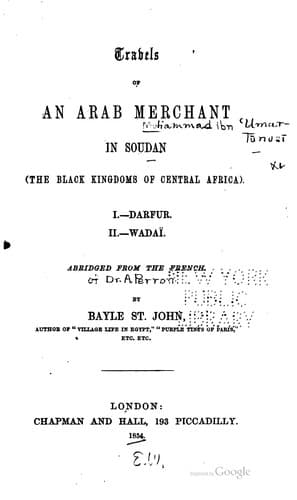
Travels of an Arab merchant in Soudan (the Black Kingdoms of Central Africa)Tūnisī, Muḥammad ibn ʻUmar
History
Travels of an Arab merchant in Soudan (the Black Kingdoms of Central Africa)
Tūnisī, Muḥammad ibn ʻUmar
Darfur (Sudan) -- Description and travel; Wadai (Sultanate) -- Description and travel
Sultan Tyrab one day gave a great festival. The Sultan began
examining the dishes one after another, in order to see which were
the best. Some of them had been prepared by the hands of the Yakoury
Kinaneh herself. Tyrab tasted them, and, finding them excellent,
ordered them to be reserved for the Ulemas. Kinaneh objected,
saying,—“Shall I be Yakoury to cook for Sheikhs, whilst others
cook for Viziers and Kings?” The King replied, that she would
thereby gain the blessings of these holy men. But an altercation
ensued; she swore by her head that the Ulemas should not taste them,
and female perseverance prevailed.
I must add that the buffoons are generally chosen amongst the
poorest kind of people. They go begging from door to door, always
with success, for the great people fear them as spies. Whoever treats
them well acquires their praises; but those who seem to check them
are sure to be despised and scandalised. In this they resemble
poets, who have incense for their friends and sarcasms for their
enemies. The Yakoury is the mother of the Sultan. I have seen the
mother of Sultan Mohammed Fadhl. She was an ugly slave, who would not
have fetched ten dollars. I have also seen his grandmother, a hideous
old woman, more hideous than any other in the whole country, and
nearly imbecile. It was her pleasure, whenever she travelled, to be
carried on a kind of stool on the shoulders of men, and surrounded by
a numerous escort of soldiers. One day she was told that the people
said, speaking of her, “This slave tyrannises over and torments
us.” She caused herself to be carried to the divan, and cried,
“The slave! The slave has brought forth silver, and silver has
brought forth gold!” alluding to her relationship to the Sultan.
CHAPTER VII.
The Fasher — The Ligdabeh — A Race — Audience on Horseback —
Tendelty — Fountains — Huts — The Palace — Police Regulations
— Costume — The Litham — Materials of Clothing — Women’s
Dresses — Ornaments — Lovers — Jealousy — Intercourse of
the Sexes — A Story of Love — The Sultan’s Interference —
War against Drunkenness — Marriage Expenses — Strange Customs
— Buying a Wife — Betrothal.
Public-domain text, read in full here on John Shaqi.
Reviews
Reviews
No reviews yet
Be the first to share your thoughts on this work.
Join the Discussion
Join the discussion
Sign in to leave a comment or review.
Sign InorCreate an account