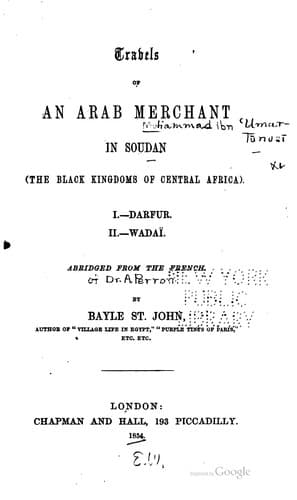
Travels of an Arab merchant in Soudan (the Black Kingdoms of Central Africa)Tūnisī, Muḥammad ibn ʻUmar
History
Travels of an Arab merchant in Soudan (the Black Kingdoms of Central Africa)
Tūnisī, Muḥammad ibn ʻUmar
Darfur (Sudan) -- Description and travel; Wadai (Sultanate) -- Description and travel
The dwelling of the Sultan is in the interior of the Fasher;
that is to say, the town or borough which is chosen for his
ordinary residence, and the houses or huts of the inhabitants
around. This dwelling-place has two external gates, one called
the gate of the men, and the other the gate of the women. The
first leads to the great divan, which is a shed built of wood,
open on all sides. Large beams support the roof, which is made of
fascines. The ceiling is now sufficiently high to allow a man upon
a camel to ride through. Formerly, only a man on horseback could
pass. It happened, one day, that two Arabs presented themselves,
and quarrelled about their skill in camel-riding. It was agreed
that they should have a race within the Ligdabeh, or divan. The
Sultan and his courtiers went out and collected around to see this
singular contest. The two champions started off from a distance at
full gallop. On arriving near the Ligdabeh, one of them leaped upon
the roof, and, running along, dropped into his seat again just as
the camel came out at the other side. The other threw himself under,
and held on until he was also outside, when he swung up again into
his seat. There was a great discussion as to who had gained the
bet; but the Sultan decided in favour of the second. It was after
this incident that the roof was raised to its present height. When
there is a public meeting, the Sultan sits on an elevated seat,
placed on a platform in the midst, with the Ulemas on the right,
and Shereefs and great people on the left. When a solemn divan is
held for the reception of ambassadors, or for a public festival,
the platform is decorated with trappings embroidered with gold, and
a stool of ebony, with a cushion of silk, is placed in the midst
for the Sultan, who assumes an imposing and majestic air. All the
great dignitaries and the seven interpreters have their appointed
place. On some occasions, the Sultan gives audience on horseback,
and has horses trained to remain for hours in the same posture.
Tendelty is now the capital of Darfur, and has been so ever since
1206, or 1791 of the Christians. It is built on a plain of sand,
and traversed by a torrent, which joins the great stream of the
valley of Kou. The rains of autumn fill it, so that it can only
be crossed at a great distance from the city. Towards the end
of winter, the greater part of the water dries away, and wells
are dug in the sand. The Sultan uses this water; but, as he fears
that some ill-intentioned persons may cast a charm into the well,
he sometimes, without warning, sends to the well of Gedeed el Seil,
which is distant about a parasang to the east.
Public-domain text, read in full here on John Shaqi.
Reviews
Reviews
No reviews yet
Be the first to share your thoughts on this work.
Join the Discussion
Join the discussion
Sign in to leave a comment or review.
Sign InorCreate an account