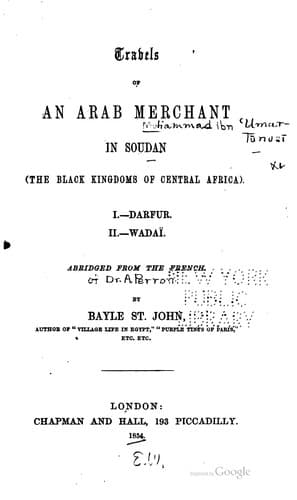
Travels of an Arab merchant in Soudan (the Black Kingdoms of Central Africa)Tūnisī, Muḥammad ibn ʻUmar
History
Travels of an Arab merchant in Soudan (the Black Kingdoms of Central Africa)
Tūnisī, Muḥammad ibn ʻUmar
Darfur (Sudan) -- Description and travel; Wadai (Sultanate) -- Description and travel
To the above musical entertainment are added the songs of the
Maugueh, who form a considerable corporation, having a special
king. They have not only to perform the droll duties of buffoons, but
many others, and especially the horrible one of executioner. Commonly
the Maugueh wear a kind of band round their heads, with a plate of
iron on their foreheads, in which is loosely fastened a long horn or
nail, which shakes and tinkles as they move. This is shaded by one
or two ostrich-feathers. They wear iron anklets, and each carries
a leathern bag in which to place these ornaments, as well as their
tartour, or tall, conical cap, covered with shells and beads, when
they have finished their sittings. In their hands they carry a crook,
to which are suspended little bells.
Two or three of these buffoons generally stand up before the Sultan
when he holds a divan; and when he travels or hunts several go before
him, singing, dancing, mimicking the bark of a dog or the mewing
of a cat, and uttering various absurdities to create a laugh. Their
songs are in the Forian language, never in Arabic. Their dance does
not consist of contortions of the hips, like that of Egypt, but they
shake the head from one side to the other, and, striking their legs
together, make their anklets jingle. When the Sultan is very far from
the Fasher they cease to sing, but all together, at the top of their
voices, cry, “Ya! ya!” as long as the prince is on horseback.
Every governor has buffoons of his own. These odd beings care little
for the anger of their master. They have a right of familiarity,
even with the Sultan. They conceal nothing that they learn against
the private character of the courtiers, but bawl out their scandalous
stories in full divan. They have stentorian voices, and are also
used as criers. They may often be heard after sunset screaming out
in the streets.
The Sultan Abd-er-Rahman loved the Ulemas, and was frequently with
them night and day. He never appeared in council without having
one or two with him. This difference excited the jealousy of the
Viziers. “What,” said they, “does the Sultan prefer these
fellows to us? Verily, after him we will take care not to put upon
the throne a Sultan who can read and write.” A Maugueh heard these
words, and, dissimulating, waited for a day of public assembly. The
Viziers were present, and the buffoon began to say, “Certainly, we
will take care not again to elect a Sultan who can read and write.”
The Sultan turned round and inquired, “Wherefore?”
“Because thou preferrest the company of the Ulemas to that of
the Viziers.”
Irritated at this observation, the Sultan glanced furiously at him,
so that he feared for his skin, and added,—“I am not to blame,
for I overheard these people,” pointing to the Viziers, “say
these words.”
This created a scene of reproach and anger, and suggested to me this
observation,—“The ignorant are always enemies of the learned.”
Public-domain text, read in full here on John Shaqi.
Reviews
Reviews
No reviews yet
Be the first to share your thoughts on this work.
Join the Discussion
Join the discussion
Sign in to leave a comment or review.
Sign InorCreate an account