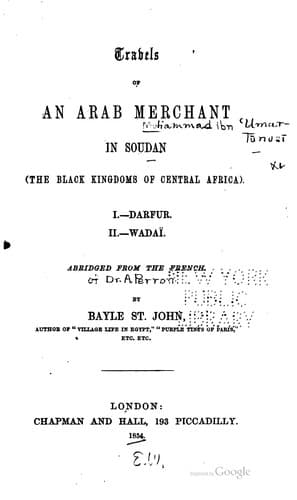
Travels of an Arab merchant in Soudan (the Black Kingdoms of Central Africa) — John Shaqi
Travels of an Arab merchant in Soudan (the Black Kingdoms of Central Africa)Tūnisī, Muḥammad ibn ʻUmar
History
Travels of an Arab merchant in Soudan (the Black Kingdoms of Central Africa)
Tūnisī, Muḥammad ibn ʻUmar
Darfur (Sudan) -- Description and travel; Wadai (Sultanate) -- Description and travel
The dwellings of the Forians are generally huts constructed of
millet-stalks, and are surrounded with a hedge of prickly bushes, at
some distance, and by a second enclosure of millet-stalks. Wealthy
persons possess many huts within the same enclosure. The wealth of
a man is known by the whiteness and cleanness of his huts, and the
inner enclosure. There are pens within the hedge for the flocks.
The huts are round, and resemble tents in appearance. They are of
different classes and names. Some of them are surmounted by a stick,
on which are three or four ostrich eggs, separated by balls of red
clay. In addition to these, the huts of the Sultan are ornamented
with horizontal bands of red and white stuff. Those of the women of
the Sultan, and, indeed, of many wealthy people, have the external
wall of mud, and the roof of a rare kind of reed, the possession
of which is considered a sign of wealth.
The imperial enclosure is situated on a slight elevation, a little
to the north of the torrent, and covers an extent of three hundred
paces. The hedge is very thick, and is formed of three rows of
prickly shrubs, with the spaces filled up by trunks of trees. The
whole forms a regular palisade, surpassing the height of a man,
and is carefully kept in order. The gates, which are well guarded,
are made of long poles tied together, and are fastened with an
iron chain and padlocks. A great number of dwellings and offices
are included within the enclosure. The women occupy a considerable
space, and there are several sheds where slaves are engaged all
day in grinding millet and wheat between two stones.
All the inhabitants of Tendelty are compelled to remain, invariably,
in the quarter of the city where they are first established,
from father to son. All people employed, also, are forbidden to
change their place. This rigid rule is ever preserved upon warlike
expeditions. Every one is compelled to encamp exactly in the same
relation to the Sultan’s tent, so that, in fact, at every halt,
a miniature representation of the city is created. In this way,
if the Sultan is in want of anybody, it is always possible to find
him immediately.
Public-domain text, read in full here on John Shaqi.
Reviews
Reviews
No reviews yet
Be the first to share your thoughts on this work.
Join the Discussion
Join the discussion
Sign in to leave a comment or review.
Sign InorCreate an account