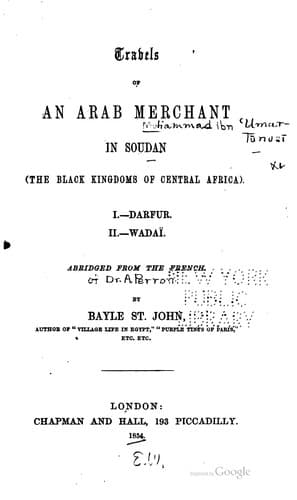
Travels of an Arab merchant in Soudan (the Black Kingdoms of Central Africa)Tūnisī, Muḥammad ibn ʻUmar
History
Travels of an Arab merchant in Soudan (the Black Kingdoms of Central Africa)
Tūnisī, Muḥammad ibn ʻUmar
Darfur (Sudan) -- Description and travel; Wadai (Sultanate) -- Description and travel
The garments worn in Darfur are all light, but of various forms
and colours. Rich people have black or white dresses of very fine
tissue. The Sultan and other great people wear two long shirts
of fine stuff, imported from Egypt, or made in Darfur. The white
garments are very brilliant, and all clothing is kept perfectly
clean. The Sultan wears a Cashmere turban on his head, which no
one else is allowed to do. Moreover, he wraps up his face with a
piece of white muslin, which goes round his head several times,
covering his mouth and nose first, and then his forehead, so that
only his eyes can be seen.[17] The Orondolon and the Kanineh,
and the male children of the royal family, also cover their face,
except when they are in the palace. The Sultan is also distinguished
by a gilded scimetar, by his sacred amulet box, by his parasol and
fans of feathers, by his gilded saddle and stirrups, and by the
peculiar trappings of his horse.
The stuff with which the rich clothe themselves commonly are
muslin and English calico: silk dresses are only used on great
occasions. The Forians, who are well off, wear a kind of mantle,
in several different ways. Some curious stuffs are imported from
the West: among others, the Gadany, which is black, with a shade
of red. The dye used is indigo. People who can afford it wear
drawers, and upon their heads the tarboosh, or red cap. The poor
go bare-headed, and cover their bodies with a single garment.
The women wear a piece of stuff tied round the waist, and the young
girls hide their bosoms with a kind of kerchief made of silk, of
calico, or of coarse stuff, according to their means. All the girls
wear round their middle a thick band and kind of kilt. When a girl
is married, she wears a great izar, which covers her from head to
foot. Most women have a ring in their nose, sometimes of gold, but
often of silver or copper. It sometimes bears a few beads of red
coral. Many wear great ear-rings of silver, six ounces in weight,
supported, in part, by a string, which passes over the head. The poor
thrust a little piece of red coral or a long bead through the hole
in their nostril, and pieces of stick through their ears. They wear
various kinds of necklaces, made of beads, of amber, of coral, of
agate, and of glass. These, indeed, form their principal ornaments;
but they are also fond of wearing little talismanic chaplets about
their heads, made of berries, of beans, or of shells. The Forian
women also cover their bodies with various strings of beads, load
their arms with bracelets made of iron, of horn, or of copper,
and the ankles with anklets. They use different kinds of perfumes:
among others, the sun-bul, or _Spica Celtica_, sandal-wood, and
myrtle. Great people carry musk-bags.
Public-domain text, read in full here on John Shaqi.
Reviews
Reviews
No reviews yet
Be the first to share your thoughts on this work.
Join the Discussion
Join the discussion
Sign in to leave a comment or review.
Sign InorCreate an account