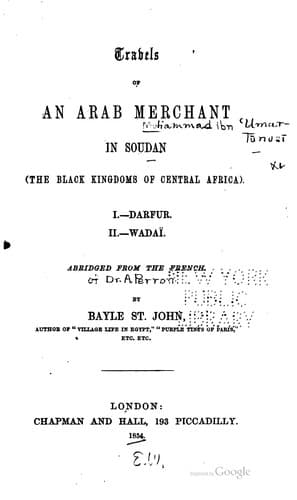
Travels of an Arab merchant in Soudan (the Black Kingdoms of Central Africa)Tūnisī, Muḥammad ibn ʻUmar
History
Travels of an Arab merchant in Soudan (the Black Kingdoms of Central Africa)
Tūnisī, Muḥammad ibn ʻUmar
Darfur (Sudan) -- Description and travel; Wadai (Sultanate) -- Description and travel
A distinguished man of Darfur once had seven sons and a daughter of
perfect beauty. Many suitors presented themselves for the latter,
but were refused. Time passed, and the young girl had recourse
to stratagem, and introduced into her hut a handsome youth full
of courage and resolution. They remained together as long as
it pleased God. His parents, disquieted by his absence, sought
for him everywhere, but found him not. However, one day, having
drunk deeply with his mistress, he became excited, and wished to
go forth. “Wait until the night,” said she. But he refused,
and went out. It happened, however, that the father and his seven
sons were sitting at the gateway of the enclosure, and perceived
him as he approached. The father cried out to the gatekeeper to
shut the gate, and to seize on the intruder. He was assailed and
surrounded, but defended himself so vigorously that many were
wounded. The seven brothers now ran towards him armed, in order
to kill him. He begged them to stand aside; but they would not,
and fell upon him. They fought for some time, but he killed six,
one after the other, and wounded the seventh. Then the father cried
out, “Open the gate!” and it was opened, and he escaped without
a single wound. No one ever knew who he was. The young girl was
thus the cause of the death of her brothers and the desolation of
her family. Similar adventures happen often, and the women always
refuse to betray their lovers. Great ugliness, or ill-health,
can alone preserve a daughter to her family.
Sultan Abd-er-Rahman endeavoured to repress these abuses, but without
success. He established a police of eunuchs to prevent conversations
between men and women in the market-place, but they were deceived
in a thousand ways. If a man, for example, wanted to point out to
a young girl, whom he found to his taste, where she might meet him,
he would cry out,—
“Oh, ho! my lass, what’s this? Thy ugly head is like the ugly
top of that ugly hut.”
“What ugly hut?” would the cunning girl say, in a tone of sham
anger. “Where is that ugly hut which is like my head?”
“There.”
So he pointed it out, and in the evening she was sure to come and
meet him.
Abd-er-Rahman endeavoured, also, to put a stop to wine-drinking,
but with equal want of success. He even went so far as to smell the
mouths of his courtiers when they came to see him; but they soon
found out that, by chewing the leaves of a certain plant, named
shalaub, they could entirely take away the odour. The Forians are
naturally drunkards, and religion has no power to keep them sober.
Public-domain text, read in full here on John Shaqi.
Reviews
Reviews
No reviews yet
Be the first to share your thoughts on this work.
Join the Discussion
Join the discussion
Sign in to leave a comment or review.
Sign InorCreate an account