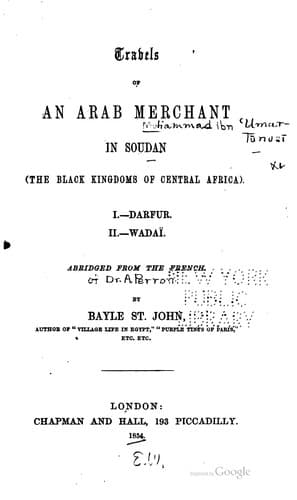
Travels of an Arab merchant in Soudan (the Black Kingdoms of Central Africa)Tūnisī, Muḥammad ibn ʻUmar
History
Travels of an Arab merchant in Soudan (the Black Kingdoms of Central Africa)
Tūnisī, Muḥammad ibn ʻUmar
Darfur (Sudan) -- Description and travel; Wadai (Sultanate) -- Description and travel
When a poor man is about to marry, and nobody of his family will
give him enough to supply his bridal expenses, he goes out to the
fields, where the herds and flocks of his relations are feeding,
and slaughters as many as he wants. If the owner endeavours to repel
him, he is sure to be beaten, and, perhaps, killed; but, generally,
he cites the man before the Khadi, who condemns him to pay for what
he has taken by instalments.
On the occasion of a circumcision, the very young boys of a village
are sent out into the neighbouring districts to kill all the fowls
they can come near. No one attempts to interfere with them, for the
law does not allow punishments to be applied at so early an age. A
similar custom to the one here alluded to is practised in the case of
young girls; and a very extraordinary method is taken among the poor
to forestall the dangers of familiarity. During all these painful
ceremonies, the girls are expected to suffer without complaint.
Very considerable dowries are given at a marriage, or rather a high
price is paid for a wife. If the girl be pretty, her parents, even
though poor, sometimes require twenty cows, and a male and female
slave; but the father and mother keep all this for themselves. For
this reason the Forians prefer daughters to sons. Daughters fill
the stables, say they, but sons empty them.
Once married, a girl remains for one or two years in her father’s
house, along with her husband, who at last has great difficulty
in taking her away. During this time all domestic expenses are
defrayed by the wife’s father; and whatever the husband brings is
considered as a present. When a youth has been betrothed to a girl,
however intimate he may have been with her parents before, he ceases
to see them until the ceremony has taken place, and even avoids them
in the street. They, on their part, hide their faces, if they happen
to meet him unexpectedly. He goes to see his betrothed in her own
hut, and sends his compliments to her parents. After the ceremony
he goes and kisses his father-in-law and his mother-in-law on the
head, and becomes one of the family. From this time forward both
wife and husband consider that they have two fathers and two mothers.
CHAPTER VIII.
Origin of Marriage — Apologue — Dowries — Ceremonies — Dances
— Songs — Formalities — Festivals — Domestic Etiquette —
Zikrs — Jealousy — Eunuchs — A Miracle — Impious Ab-Sheikh
— The Sultan’s Wives — A faithful Woman wanted — Arab
Fidelity — The Queen Mother — An Adventure — Beautiful Women
— Qualities of Black Women.
But I must enter into further details on this subject of
marriage. When Adam woke from the light sleep during which Eve was
taken out of his side, and beheld this new creature, richly adorned
with grace and beauty, his heart was moved, and he admired.
“Who art thou, dear creature?” said he.
“I am Eve. God has just created me for thee, according to the
dictates of his supreme will.”
“Come, then, to me.”
Public-domain text, read in full here on John Shaqi.
Reviews
Reviews
No reviews yet
Be the first to share your thoughts on this work.
Elsewhere in the archive
Join the Discussion
Join the discussion
Sign in to leave a comment or review.
Sign InorCreate an account