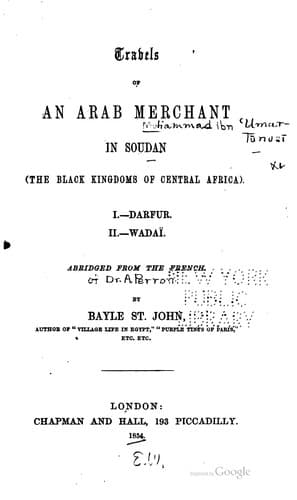
Travels of an Arab merchant in Soudan (the Black Kingdoms of Central Africa)Tūnisī, Muḥammad ibn ʻUmar
History
Travels of an Arab merchant in Soudan (the Black Kingdoms of Central Africa)
Tūnisī, Muḥammad ibn ʻUmar
Darfur (Sudan) -- Description and travel; Wadai (Sultanate) -- Description and travel
I shall now describe what is called a Zikr in Darfur, remarking, by
the way, that, in common Forian life, the women are the life and soul
of every thing that takes place, and that, therefore, they also take
a direct part in this religious ceremony. The Darfur Zikr is of two
kinds, one performed by the Arabs, and the other by the Forians. The
former contains a variety of movements and change, and was instituted
by a celebrated Sheikh. A woman places herself near the circle of
the faithful, and sings a few verses, whilst the other women simply
look on, and examine who is most distinguished by his enthusiasm.[18]
When the Zikr is in full swing, the woman becomes silent, and one of
the men takes up the song. On one occasion, I heard a contest between
two circles of Zikrs, in which the performers sung satirical verses
one against the other. At another time, a woman ran into the circle,
and began to chant:—“I will pour out for you a jar of meriseh. I
am without a husband, and I live at the other end of the village. Is
there one of you who is ready for love?” The people of the Zikr
were then chanting,—“Allah hai! Allah hai!”—God is living,
God is living! but one of them substituted the words “Ana zany;
ana zany!”—I am your man; and so the contract was made.
The people of Forian origin stand in two rows or in a circle, each
one with a young girl behind him, and the women standing around chant
in a monotonous tone these words:—“The green tree is created for
the shadow of men of science and religion. Is it indeed true that
we shall go to paradise? Yes, it is indeed true that we shall go
to paradise:” and they also add these words:—“Oh Gabriel! oh
Michael! every deed of goodness is a key of paradise.”
Women in all countries have excited the jealousy of men. There
have been known those who have been jealous not only of their
nearest relations, but of the night, of the day, of the eyes of
the Narcissus, even of themselves. The poets have accumulated
these exaggerations. One has said, “Oh, Narcissus, turn away thy
flower; do not look at me, for I am ashamed to kiss her I love
before thee! What! shall my cheeks grow pale in sleep, and thou
still gaze?” Another has said:—“My eyes, myself, thyself, the
place where thou livest, the hours that brush by thee, everything
excites my jealousy. Grant me nothing, for, as I am jealous of thee
against thyself, how should I not be jealous of myself?” And again,
another:—“I am jealous of everything, even of my own thoughts,
and one hand is jealous of the other.”
It is the passion thus described that has given rise to the custom
of employing eunuchs. The Sultan of Darfur has more than a thousand
of them, and all the great people possess several. All these eunuchs
come from Dar-roha, although from time to time one is made in the
country as a punishment.
Public-domain text, read in full here on John Shaqi.
Reviews
Reviews
No reviews yet
Be the first to share your thoughts on this work.
Elsewhere in the archive
Join the Discussion
Join the discussion
Sign in to leave a comment or review.
Sign InorCreate an account