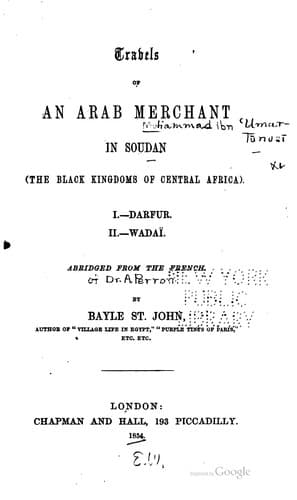
Travels of an Arab merchant in Soudan (the Black Kingdoms of Central Africa)Tūnisī, Muḥammad ibn ʻUmar
History
Travels of an Arab merchant in Soudan (the Black Kingdoms of Central Africa)
Tūnisī, Muḥammad ibn ʻUmar
Darfur (Sudan) -- Description and travel; Wadai (Sultanate) -- Description and travel
Next day, the bride and her bridemaids take a bath and perfume
themselves, and the whole wedding party prepares for a new festival;
and sometimes the rejoicings last for seven days, in the evenings of
which there are always dancing and other amusements. If provisions
fail, the men of the party spread through the neighbourhood, and
kill what they want in the first flocks and herds they find. For
this reason all the farmers, as soon as they hear that a wedding
is to take place, drive away their beasts to a distance.
It must be observed that the marriage is seldom considered as
completely celebrated until the seventh day, and never until
after the third. A husband always shuns the insulting epithet of
the impatient man. Each day of temperance is dedicated to some
particular person: the first to the father of the bride, the second
to the mother, and so on.
It is a strange custom in Darfur, that the wife, under no pretence
whatever, is allowed to eat in the presence of her husband, or of
any other man. If her husband happen to enter whilst she is eating,
she instantly runs away, under penalty of universal contempt. I once
enumerated to some Forians the various liberties that a husband can
take with his wife, and asked why she should not also eat before
him. “What you mention,” said they, “are very rational and
proper acts, but for a woman to eat in the presence of a husband,
to open her mouth and introduce food therein—ah, nothing can be
more shameful!”
As I have said, the wife remains in her father’s house until she
has borne children; and if her husband propose to take her away,
she may ground a demand of divorce thereon. In the early time of
her marriage the wife never speaks of her husband by his name,
but only as _he_; and if she be asked whom she means, she replies,
_him_. When she has had a child she uses the expression,—The father
of such a one. The husband has no family expenses until after a year
of marriage, and at every repast all the best food is first offered
to him. During the night also, as long as he sleeps in the house of
his wife’s family, they bring him, in the course of the night,
two or three supplemental meals; the first of which is called the
undress meal; the second, the Tarna-jisi; and the third, the meal of
dawn. These meals are served up to the husband by the bride herself.
At the festival of the circumcision there are also great
rejoicings. The operation is performed by a barber, and if the
patient support it courageously the father promises him a heifer,
a bull, or a slave, and all those who are present make him some
gift. It is on this occasion that the boys scour the country in
search of fowls.
Public-domain text, read in full here on John Shaqi.
Reviews
Reviews
No reviews yet
Be the first to share your thoughts on this work.
Elsewhere in the archive
Join the Discussion
Join the discussion
Sign in to leave a comment or review.
Sign InorCreate an account