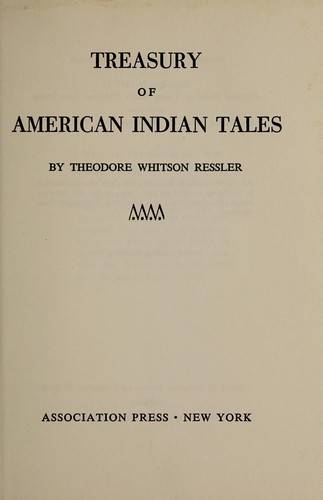
Treasury of American Indian TalesRessler, Theodore Whitson
General
Treasury of American Indian Tales
Ressler, Theodore Whitson
Indians of North America -- Folklore; Indians of North America -- Juvenile literature
Crying Hawk started to complain, but Little Snapping Turtle silenced
him. He pulled the other boy to his feet and, shoving the container into
his hand, sent him on his way. With the new moccasins, the boy ran more
easily and soon was out of sight. Little Snapping Turtle picked up
Crying Hawk’s container and put his feet into the ill-fitting moccasins.
He trotted slowly after Crying Hawk, keeping just far enough behind to
make sure the boy would win.
He heard several pairs of feet moving swiftly along the trail just in
back of him. From here to the meadow, the trail narrowed and only one
boy could use it at one time. So Little Snapping Turtle kept his slow
pace and kept the others from passing Crying Hawk. Little Snapping
Turtle could see the clearing now and he sped toward the meadow. There
he saw Crying Hawk standing proudly next to Little Snapping Turtle’s
father. He ran up to Crying Hawk.
“Say nothing of what happened on the trail,” he whispered. “You have run
a good race, Crying Hawk.”
Soon all the boys were back and the inspection of the containers began.
When Big Snapping Turtle had seen all of them, he stepped to the front
and declared Crying Hawk the winner. Everyone cheered as the boy
received the knife and belt from the smiling Medicine Man. Then they all
started back toward the village to place the fish in the stream and then
go home.
As Little Snapping Turtle and his father walked along the trail, the
Medicine Man asked, “Where did you get that container, my son?”
Little Snapping Turtle blushed as he looked up at his father, but his
father smiled. “It is well, my son. I knew each container that I had
given out and at the end of the race you did not have the one you had
started with. I also noticed the beautiful moccasins that Crying Hawk
was wearing. I discovered, too, how big my son’s heart really is. Today
you lost a race, but the happiness you won is the best possible prize.”
THE MYSTERIOUS PONY RAIDERS
Among the American Indians truth was respected as most sacred. Parents
took great pains to teach their children that above all else, a good
Indian was one who had honor and spoke nothing but the truth, or, as the
Indians would say, spoke with a straight tongue. It is about the power
of truth that this story is told.
The Blackfoot Indians were a wandering tribe of the Western plains.
Their very lives depended upon the great buffalo herds. From the buffalo
meat and hides, the Blackfeet were able to get their food, skins for
clothing, and their tepees; and from the head, horns, and tail,
decorations for costume and headdress.
Blackfoot villages were always moving, since they were set up near the
grazing herds of buffalo. When the herd moved, the whole tribe would tie
its belongings onto travois drawn by horses, and move with the buffalo
until the animals stopped once again to graze where there was more
prairie grass.
Public-domain text, read in full here on John Shaqi.
Reviews
Reviews
No reviews yet
Be the first to share your thoughts on this work.
Elsewhere in the archive
Join the Discussion
Join the discussion
Sign in to leave a comment or review.
Sign InorCreate an account