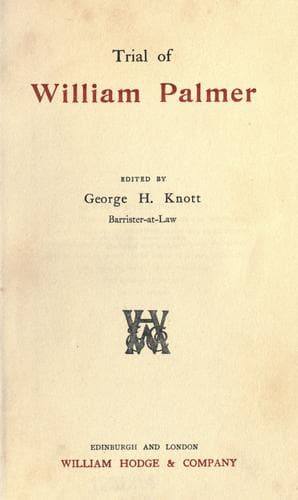
Cook, John Parsons, -1855; Palmer, William, 1824-1856 -- Trials, litigation, etc.; Trials (Murder) -- England -- London
than Monday night’s post.” Pratt writes acknowledging the receipt of the
document, saying he will send him his money to Doncaster, and endeavour
to let Cook have his money at the same time. On the 10th of September
Palmer writes to Pratt that he must send him for Mr. Cook £385 instead
of £375 and the wine warrant, so that he can hand it to him with the
£385. Accordingly, here is an intimation that Cook, who wanted the money
on the very day, was inconvenienced by only getting a cheque on London
which he could not immediately change, and therefore Palmer gave him the
money and took the cheque. It is remarkable, when we look at the banking
account of Palmer at Rugeley, the £375 is paid in by somebody to
Palmer’s account, but the £315 is not paid into Palmer’s account at all;
that is the only sum paid in on that day, so that I put it to you upon
these facts, Pratt saying in a letter which accompanies the money, “I am
obliged to send a cheque for Mr. Cook, for I have not received the
money, which I shall do no doubt to-morrow”; so that not being able to
send cash to the full amount he is obliged to do that which did not suit
Cook; he sent him a cheque which he could not cash on the day he got it;
he is obliged to send it to London unless he could find some friend down
there, and that delays him for a whole day. I submit to you as the true
version of the transaction that the bill was accepted for Cook’s
accommodation; Cook gave as security for it the two horses, “Polestar”
and “Syrius”; Cook never complained to Pratt during the rest of his life
that he had not received the money upon it. It appears in the
correspondence that Cook wanted the ready money, and that he wanted it
on Saturday, and it would be probably inconvenient if he had got it a
bit later than Monday; though Palmer would not promise to get it sooner
than Tuesday. What says Palmer in his letter, which is not written for
the purpose of this case, but written at the date of this transaction,
that he, Palmer, would let Cook have the cash that was sent, and he
himself take the cheque with Cook’s authority, and put Cook’s name on
the back of it; and how else can you account for the silence of Cook,
for the fact that the £375 is paid into the account of Palmer at
Rugeley, and no trace of the other large sum of £315? That is well
worthy your consideration. You cannot account by any reasonable mode for
the fact that the security given for that £500 was Cook’s horses, and
Cook remaining quiet about it for three months after he had executed a
regular bill of sale, except the supposition that it was for Cook’s
accommodation, and Cook got the best part of the money; and, if so,
Palmer’s name being on the bill, what is the effect of Cook’s death?
Gentlemen, what Pratt, who knew all about it, says is, “The death of
Cook makes you liable for that sum of £500 due on the 2nd December.” I
submit to you, on the second ground of motive, which my learned friend
Public-domain text, read in full here on John Shaqi.
Reviews
Reviews
No reviews yet
Be the first to share your thoughts on this work.
Elsewhere in the archive
Join the Discussion
Join the discussion
Sign in to leave a comment or review.
Sign InorCreate an account