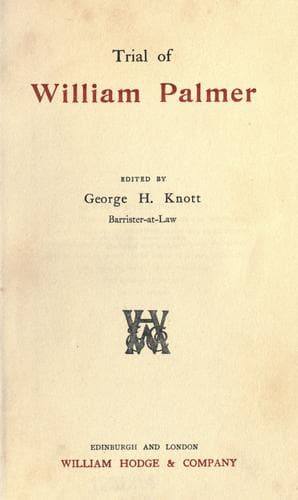
Cook, John Parsons, -1855; Palmer, William, 1824-1856 -- Trials, litigation, etc.; Trials (Murder) -- England -- London
was pressed to pay that £500, and Cook was dead, there was nothing to
save him from the exposure. Nothing! If you doubt what I say is the
truth, look through the whole of the case--find me in any portion of
this most voluminous evidence the slightest trace that there was a man
in the world who would lend his name to Palmer to enable him to get
money. Is not the fact that he forged, if he did forge, the name of his
mother conclusive that he had no other resource? Is there the least
trace of evidence that he had any other resource than the good nature,
the easiness, perhaps the folly, of Cook, who could have renewed these
bills for him--the three £200 bills and the £500--and put them on as
they say? And was it not quite certain that if Cook, the acceptor of
them, dropped, the claim would come upon Cook’s executors, and then the
executors would ascertain all about it and sell him up? When you come to
think of it, is it credible that the man under those circumstances
should desire to bring not merely the creditors and executors of
Cook--who might be supposed, though Mr. Stevens is not one of that
class, to have some pity for Cook’s friend--but men of business, down
upon him, who have no right to have any pity? A man dies, his affairs
are put into the hands of solicitors; they have a plain duty to perform,
they cannot be compassionate, they must be just; they must see the
rights of their clients the executors established in due course of law,
and compromise and arrangement with them is wholly out of the question.
Can you find in any part of this case a single living person who was
willing to have done for Palmer what Cook had been doing for him for two
or three years? Does it appear that there was one? Does it appear that
Cook was a close-fisted fellow, and did not care to do Palmer a turn?
When Palmer needed the £200, which the harpy wanted from him, Cook at
once wrote and said it is a matter of great importance to him as well as
Palmer that this £200 should be paid; and he even risked the displeasure
of Fisher in doing it. Then, again, Cook was in his senses perfectly on
the Tuesday. He cannot have been very rich at that time. He gave him the
cheque for £350. How is it possible to conceive that under those
circumstances Palmer should have an interest in the death of Cook, and
yet what is the theory of the Crown? That Palmer was convinced that he
could settle his affairs as to Cook better with Mr. Stevens than he
could with Cook himself--settle these word-of-honour transactions; these
things, half of which would not bear inquiry in any way as reasonable
business transactions, with a shrewd and probably a penurious
man--deliberately thought that it would answer his purpose better to
come in contact with his executor, Mr. Stevens, whom Mr. Jones might
rush up to town and bring down with him. I submit to you with
confidence, though what I say may be inconsistent with the views
generally entertained by the public--the public, however, have never had
Public-domain text, read in full here on John Shaqi.
Reviews
Reviews
No reviews yet
Be the first to share your thoughts on this work.
Elsewhere in the archive
Join the Discussion
Join the discussion
Sign in to leave a comment or review.
Sign InorCreate an account