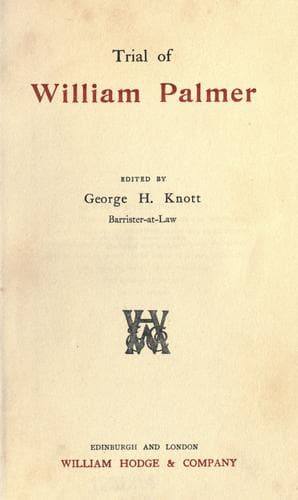
Cook, John Parsons, -1855; Palmer, William, 1824-1856 -- Trials, litigation, etc.; Trials (Murder) -- England -- London
Gentlemen, let me ask you in what position we are placed for the safety
of our lives and families if, upon such evidence as this, upon
suspicions so excited and so sanctioned by hasty opinions of medical
men, we are liable every time a sudden death takes place in a family to
be put upon our trials on suspicion of foul play to those with whom we
live? In the cases which are usually discussed in this Court, witnesses
are called to give evidence respecting processes and means of arriving
at truth with a knowledge of the facts in question, with the operation
of which processes the prosecuting counsel, the judge, and the jurors
are as well acquainted as the witnesses themselves. The witnesses come
to speak to facts, a great portion of which are within the ordinary
knowledge and appreciation of mankind; but if science is admitted to
dogmatise in our Courts--science not exact in its nature--science not
successful, but baffled even by its own tests--science bearing upon its
forehead the motto that “a little learning is a dangerous thing”--if
that is to be introduced to state processes of arriving at truth,
conclusive to its satisfaction, but which we cannot follow, and opinions
respecting the cause of death which those processes have not discovered,
judges and jurors will have an amount of responsibility thrown upon them
too great for human nature to bear. This gentleman, Dr. Taylor, if he
had found the poison by his own tests, after long experience of their
efficacy, would have been a very good witness to have proved
unquestionably that strychnia was there; but not having found it, not
having seen the patient, and knowing nothing about him but what
Elizabeth Mills told him, and what he heard from Mr. Jones, who did not
agree with him, or who gave no evidence agreeing with him--with no
better means of information than that he thinks himself justified, upon
his oath in a public Court, to say that the pills administered by the
medical man (of course, he did not mean to impute any misconduct to Mr.
Bamford) contained strychnia, that murder was committed, and Cook
poisoned by it. If he is allowed to say that, what family and what
medical practitioner is safe? Gentlemen, I beg to ask you on what ground
does he say that? Not on any peculiar knowledge, for he has not any
knowledge as to the effects of strychnia more than any of us--myself, if
you please; for when we come thoroughly to look into it he does not
appear, of his own knowledge, to have seen a single case of strychnia in
the human subject; and yet he has been daring enough, knowing that the
consequences would be disastrous to this man--knowing perfectly well
that all the world, or, at all events, the great majority of the world,
would take for granted that a medical man in his position would not give
a hasty opinion--he has the incredible courage to declare, on his oath,
that the pills that were given, as far as he knew, by Dr. Bamford,
contained strychnia, and that Cook was poisoned by them!
Public-domain text, read in full here on John Shaqi.
Reviews
Reviews
No reviews yet
Be the first to share your thoughts on this work.
Elsewhere in the archive
Join the Discussion
Join the discussion
Sign in to leave a comment or review.
Sign InorCreate an account