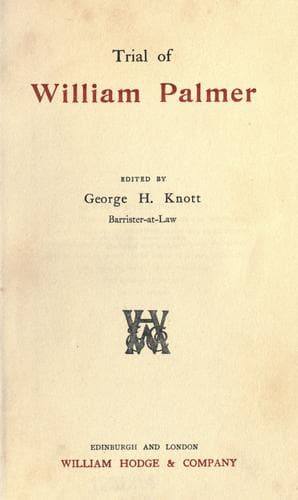
Cook, John Parsons, -1855; Palmer, William, 1824-1856 -- Trials, litigation, etc.; Trials (Murder) -- England -- London
I have mentioned all that I intend to say about his bodily
infirmities--let us now see what has been the state of his mind. He went
to the Shrewsbury races in imminent peril of leaving them a ruined man.
Mr. Stevens told Palmer, and we have heard nothing to the contrary, that
if anybody had claims upon him, there would not be four thousand
shillings to meet them. We know, from the necessity under which he was
to raise sums of money at exorbitant interest, that he must have been in
circumstances of the utmost embarrassment--that it was impossible,
morally speaking, unless some wonderful success on the turf restored his
fortunes, that he could stand his ground at all; and it is in this state
of mind, and with health, at all events, not strong, and a constitution
exceedingly delicate, that he had been for a length of time cherishing
the hope that “Polestar,” which was hardly his, for it was mortgaged,
and which must become another person’s if it did not win at
Shrewsbury--in all reasonable probability he had been cherishing the
hope that “Polestar” would win, and that he by that winning would
possess himself at once of the stakes, which my learned friend stated,
and I think it was proved, amounted to nearly £400, besides some
considerable winnings to the amount of £600 or £700 by bets on the
mare--upwards of £1000 altogether. That has been mentioned several
times. Fancy the condition in which that young man rose from his bed on
the Tuesday morning. He must have known and felt when he went down to
breakfast, “This night I am either a beggar, or a man with hopes of
recovering myself, and with the means, at least for the time, of keeping
up my appearance of respectability.” He goes to the races--another race
takes place before his mare, “Polestar,” is brought to the goal. He
waits for it in a state of feverish anxiety and expectation--the hour
that intervenes appears to him everlasting. At last the horses start,
and his mare wins easily--he is the winner of £1000. We may suppose that
to be the sum. What effect has it upon him? Mr. Jones tells us the
effect. He is unable to speak for three minutes. He is saved, not merely
in purse but in honour and character--saved before his relatives and
friends. He will not be a disgrace to them yet, at all events; he may
retrieve his fortunes, and become an honourable and respectable man.
Conceive him to be a man with right feelings--and it is not because a
man falls into the ways of promiscuous licentiousness that he is devoid
of all honourable feeling--conceive him to be an honourable man, a man
who loved the memory of his father and his mother, who valued the
respectability of his family, and who had a desire to appear before his
sister, Mrs. Bradford, as an honourable man, instead of being known to
her as a levanter and a blackleg, driven from all honourable society.
The effect of his success is that for three minutes he cannot speak,
though he is with his intimate friend Mr. Jones. He goes back to the
Public-domain text, read in full here on John Shaqi.
Reviews
Reviews
No reviews yet
Be the first to share your thoughts on this work.
Elsewhere in the archive
Join the Discussion
Join the discussion
Sign in to leave a comment or review.
Sign InorCreate an account