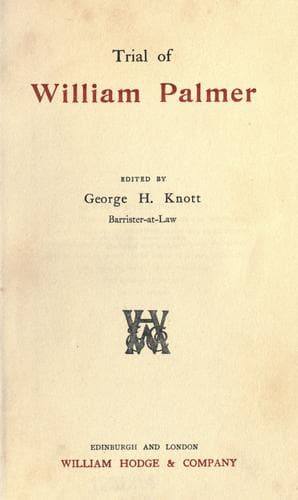
Cook, John Parsons, -1855; Palmer, William, 1824-1856 -- Trials, litigation, etc.; Trials (Murder) -- England -- London
Now, I will come to another feature of the disease, the post-mortem
symptoms of the disease. I saw three animals killed, of which I have
spoken to you, and Dr. Letheby was good enough to have dug up from his
garden a rabbit which had been killed by strychnia, and to open it
before me, to examine the heart, and the heart was full; the heart of
the dog was quite full, and the hearts of the two rabbits which I saw
killed were quite full--as full as they could possibly be. I am told
that the result of an enormous proportion of such examinations has been,
and, if properly conducted, of all of them, that the heart is full on
the right side invariably. We will prove to you that the heart of the
animal which was killed by strychnia poison is invariably full, and it
stands to reason it would be so.
[Sidenote: Serjeant Shee]
Now, I have discussed what may be said for this purpose to be the theory
of the matter, but I have not yet met the strong point which will be
made for the Crown on the evidence of Elizabeth Mills. I am, on all
occasions, most reluctant to attack a witness examined on his or her
oath, and particularly if she be in a humble position. I am very
reluctant to impute perjury to such a person. Let me point out to you
what occurs to me to be the right opinion to be formed of the evidence
of Elizabeth Mills. I submit to you in this case of life and death, or
in any one case involving any question of real importance to liberty or
to property, that that young woman’s evidence cannot and would not be
regarded in the ordinary administration of justice when on material
points she has stated two different stories. A jury can really hardly
believe such a witness, and in criminal cases the learned judges are,
without altogether rejecting the evidence and withholding it from the
jury, in the habit of pointing out to the jury the discrepancies between
the statements given at different times, and saying that under all the
circumstances of the case it would not be safe to rely on the testimony
in the last instance, if it differ from, and probably is more strongly
adverse to, the party accused than the statements made when the
impression was fresh in the witness’s mind. Now, observe that since the
first time that she gave her evidence she has had the means of knowing
what the case of the Crown is. She has had the means of knowing--I do
not mean to say she has been tutored by the Crown--it would be a gross
injustice to say so; and I know if my learned friend thought that had
been done he would not have called her--or by any of the gentlemen who
act for the Crown; but since she was examined at Rugeley she has had the
means of knowing, by interviews she has had with different people, that
the case of the Crown is, that Palmer, having first prepared the body of
Cook for deadly poison by the poison of antimony, afterwards despatched
him with the deadly poison of strychnia. She has learned that their case
Public-domain text, read in full here on John Shaqi.
Reviews
Reviews
No reviews yet
Be the first to share your thoughts on this work.
Elsewhere in the archive
Join the Discussion
Join the discussion
Sign in to leave a comment or review.
Sign InorCreate an account