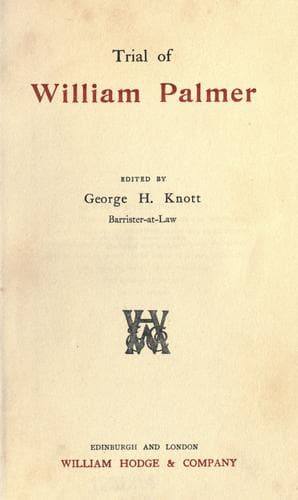
Cook, John Parsons, -1855; Palmer, William, 1824-1856 -- Trials, litigation, etc.; Trials (Murder) -- England -- London
Let me call your attention to this part of the evidence. You are aware
that in the months of February (the last week of February) and March a
very frightful case of strychnia poisoning occurred at Leeds. It was a
case in which a person, having constant access to the bedside of the
patient, was supposed to have administered repeated small doses of
strychnia so as not at once to strike her down, but gradually to destroy
her; and that after having kept her in a state of irritation for a
lengthened period, he at last consummated the work and killed her. That
was the case. It appeared in all the newspapers. The nurse who attended
the patient and the medical gentlemen spoke of symptoms which she
exhibited from the 24th or 25th February to the 1st of March, and they
described it in this way--She had “prickings” and “twitchings” in the
legs, coming on without any violent paroxysms or spasms, and was alarmed
at the thought even of being touched by anybody in the intervals of the
spasms which occurred from time to time. Now, let me call your attention
to the evidence before you of Elizabeth Mills. She says, “He said, ‘I
cannot lie down’; his body and neck were moving and jerking; he would
throw himself up, jumping and jerking all over his body all the time; he
asked me to rub his hands; I noticed him to ‘twitch’ while I was rubbing
his hands.” (The learned serjeant read a portion of the evidence.) Now,
I submit to you that some of these expressions, particularly the
twitching, are very remarkable; and it may well have been that, this
case coming before the public and exciting no little degree of
attention, although not to the same extent as this Rugeley case, persons
who had been in the habit of going to see her and conversing with her
may have been asking her questions about this case, of which she
admitted she had heard, “Did you observe in Cook any such symptoms as
these?” her attention being called to them in such a way as to induce
her to alter the statement made by her at the inquest. You cannot,
indeed, account, as I submit to you, for so remarkable a difference
between the first and second statements, without supposing something of
that kind. Now, is it improbable that that did take place? From the
time she left the Talbot Arms till she came here she seems to have been
a person of very remarkable importance. She went to Dolly’s, and Mr.
Stevens visited her six or seven times. Why did he visit here? What for?
Mr. Stevens is unquestionably--and if under proper self-restraint, no
one can blame him for it--very indignant at what he fears to have been
the foul play of Palmer with Cook. He is not in the same condition of
life as Elizabeth Mills. Why should he have gone to visit her six or
seven times, conversing with her in a private room? She says, “He only
came to see whether I liked the place; he called to inquire after my
health.” Gardner also, his attorney, saw her once, but only asked her
how she was, and they talked about other things.
Public-domain text, read in full here on John Shaqi.
Reviews
Reviews
No reviews yet
Be the first to share your thoughts on this work.
Elsewhere in the archive
Join the Discussion
Join the discussion
Sign in to leave a comment or review.
Sign InorCreate an account