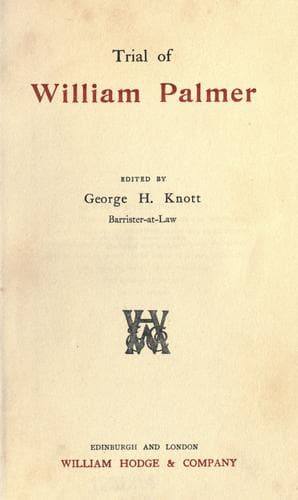
Cook, John Parsons, -1855; Palmer, William, 1824-1856 -- Trials, litigation, etc.; Trials (Murder) -- England -- London
Examination resumed--I know by my reading as a medical man that that
does occur sometimes. The degree of consciousness in epilepsy varies
very much; in some attacks the consciousness is altogether lost.
Convulsive attacks are sometimes accompanied by violent spasms and with
rigidity of portions of the body. Convulsions arising from a convulsive
disease, either from infancy or from other causes, but not exactly
tetanus, sometimes assume something of the complexion of tetanic
affection. Such convulsions might arise from any cause--worms in
children, affections of the brain in adults, hysteria, administration of
chloroform to some persons. Indigestible food will sometimes produce
convulsions in adults. I agree with Dr. Copland, whose book was referred
to yesterday, that these convulsions sometimes end immediately in death.
Asphyxia is frequently the cause of death when a man dies in one of
these convulsions. I have seen convulsions of the character I have
described recurring at various intervals, sometimes in hours, in other
cases days. The time also varies very much when a patient, suffering
from a violent paroxysm of such convulsions, becomes easier; it may be
hours or minutes. When death takes place in the paroxysm of such
convulsions it sometimes happens in post-mortem examinations that there
is no trace of organic disease in the body.
Have you known at all or frequently in persons, not further advanced in
years than the age of twenty-eight, granules between the dura mater and
the arachnoid?--They are not common to any age that I am aware of.
Do you know whether granules have been part of the symptoms of
tetaniform convulsions?--I have seen three preparations in St. Thomas’s
Hospital museum where granules are found in the membranes of the spinal
cord, in which patients are said to have died of tetanus. In order to
ascertain with satisfaction the nature and probable extent of the injury
of such granules the spinal cord should be examined immediately after
death. Not the most remote medical judgment could be formed if the
examination was made two or three months after death. If an examination
of the spinal cord is made so long after death, if there had been a
large tumour or some similar change, it might have been discovered; but
neither softening nor induration of the minute structure of the cord
could be detected. The minute nervous structures change within two hours
after death.
[Sidenote: T. Nunneley]
Public-domain text, read in full here on John Shaqi.
Reviews
Reviews
No reviews yet
Be the first to share your thoughts on this work.
Elsewhere in the archive
Join the Discussion
Join the discussion
Sign in to leave a comment or review.
Sign InorCreate an account