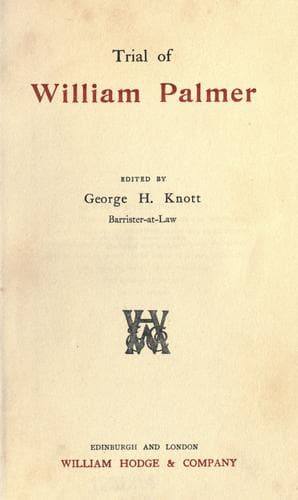
Cook, John Parsons, -1855; Palmer, William, 1824-1856 -- Trials, litigation, etc.; Trials (Murder) -- England -- London
Mr. RICHARD PARTRIDGE, examined by Mr. GROVE--I have been for many years
in practice as a surgeon, and am Professor of Anatomy at King’s College.
I have heard the evidence as to the symptoms of Mr. Cook and as to the
post-mortem examination. In my opinion it is most important in a case of
convulsion that the spinal cord should be examined after death. The
gritty granules that were found would be likely to cause inflammation of
the arachnoid membrane, which would be discoverable if the spinal cord
had been examined shortly after death. If examined nine weeks after it
is not likely it would be discovered. Although I have not seen such a
case, there are cases on record that such inflammation, if it existed,
would be capable of producing tetaniform convulsions. The medical term
for such inflammation of the arachnoid is arachnitis, or inflammation of
the membrane. That disorder produces convulsions and death. I should not
say universally; sometimes it does not result in death. I could not form
any positive judgment as to the cause of death in Mr. Cook’s case. I
have heard the evidence as to the state of contraction after death. No
inference at all can be formed of the degree of contraction, or the
kind of contraction, that I heard described. If I find the back curved
and the body resting on its back and feet after death, I should infer
that he died of that form of tetanus which convulses the muscles of the
back. Various degrees and varieties of rigidity occur after a natural
death. The clenching of the hands or the semi-bending of the feet are
not uncommon in cases of ordinary death.
Cross-examined by the ATTORNEY-GENERAL--The granules from which
arachnitis might have proceeded were, I understand, situated in the
inner surface of the fibrous investment of the cord. They are
occasionally found in these parts; not commonly. They are signs.
Arachnitis, producing convulsions, has never come under my personal
observation, nor has it satisfactorily come under my observation without
producing convulsions. It is a very rare disease.
Are you enabled to state from the recorded cases the course of the
symptoms of the disease?--No.
Do not you know it to be a disease of considerable duration?--The cases
have varied in duration; commonly days at the shortest. Arachnitis is
accompanied with paralysis if they live.
Would it, considering the connection that there is between the spinal
cord and the brain, affect the brain by sympathy, or otherwise, prior to
death?--No.
In these cases, where granules have produced arachnitis, do you happen
to know whether the granules have been considerable in point of
size?--It has varied in different cases.
Suppose them to be very small and minute?--I should think there would be
less likelihood of their producing inflammation.
Public-domain text, read in full here on John Shaqi.
Reviews
Reviews
No reviews yet
Be the first to share your thoughts on this work.
Elsewhere in the archive
Join the Discussion
Join the discussion
Sign in to leave a comment or review.
Sign InorCreate an account