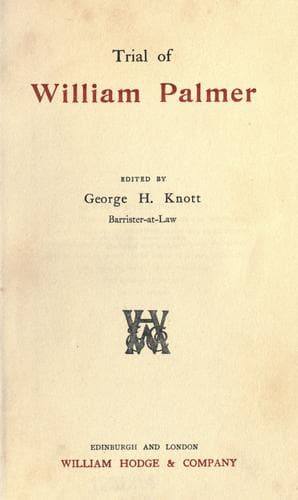
Cook, John Parsons, -1855; Palmer, William, 1824-1856 -- Trials, litigation, etc.; Trials (Murder) -- England -- London
Dr. GEORGE ROBINSON, examined by Mr. KENEALY--I am a Licentiate of the
Royal College of Physicians and Fellow of the Royal Medical Chirurgical
Society of London, and physician to the Newcastle-on-Tyne Dispensary and
Fever Hospital. I have devoted considerable attention to pathology, and
have published essays on it. I have practised as a physician for ten
years. From the symptoms I have heard described my opinion is that Mr.
Cook died from tetanic convulsions, by which I mean, not the disease of
tetanus, but convulsions similar to those witnessed in tetanus.
Convulsions of that kind occasionally assume the nature of epilepsy. I
know of no department of pathology which is more obscure than that of
convulsive diseases. I have been present at post-mortem examinations of
persons who died from convulsive diseases. I have sometimes seen no
morbid appearance whatever, and in other cases the morbid appearances
which were visible were common to a variety of diseases. Convulsive
diseases undoubtedly depend very much on the state of the nerves. They
are all connected with disorders of the nervous action. The brain has
great influence in producing convulsive diseases, but the spinal cord
has a greater influence. The presence of gritty granules in the
neighbourhood of the spinal cord would be likely to produce convulsive
diseases. There is such a disease as spinal epilepsy, which is
accompanied by strong convulsions, which might resemble in a great
degree those described in the present case. Periodicity would belong to
convulsions arising from spinal epilepsy. I should think from the
evidence I have heard that Mr. Cook’s mode of life would predispose him
to epilepsy.
Cross-examined by the ATTORNEY-GENERAL--In all cases of epilepsy there
are violent convulsions. I cannot tell you how many I have seen assume a
tetanic character; perhaps twenty.
Has it gone as far as opisthotonos?--Not the extreme opisthotonos of
tetanus. The whole body has been straightened out and the head thrown
back. I heard Mr. Jones describe Mr. Cook’s symptoms, that the body was
so bowed that he could not raise it, so bowed that it would lean upon
its heels and the back of its head if it had been turned over.
[Sidenote: G. Robinson]
Have you ever seen anything in epilepsy approaching to these
symptoms?--I have never seen anything approaching to it. I have never
seen a body so stiffened that it would rest on the head and heels.
Is that symptom peculiar to tetanus?--You may have convulsions of the
same character occurring from other causes--tetanic convulsions from the
operation of various poisons.
Public-domain text, read in full here on John Shaqi.
Reviews
Reviews
No reviews yet
Be the first to share your thoughts on this work.
Elsewhere in the archive
Join the Discussion
Join the discussion
Sign in to leave a comment or review.
Sign InorCreate an account